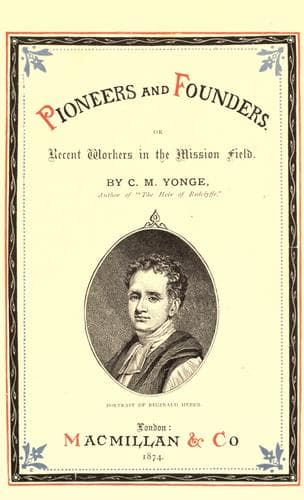
Pioneers and Founders: or, Recent Workers in the Mission fieldYonge, Charlotte M. (Charlotte Mary)
History
Pioneers and Founders: or, Recent Workers in the Mission field
Yonge, Charlotte M. (Charlotte Mary)
Missionaries
A full month had passed since leaving Grahamstown, and Gardiner decided
on pressing on upon horseback, leaving Mr. Berken to bring up the
waggons, and taking with him the interpreter and two natives. The
distance was 180 miles, and a terrible journey it was. A few waggon
tracks had made a sort of road, but this was not always to be
distinguished from hippopotamus paths, which led into horrible morasses,
where the horses almost entirely disappeared, and had to be scooped out
as it were by the hands; moreover, scarcely any food was to be had. In
crossing one river one of the horses was so irretrievably stuck in a
quicksand that humanity required it to be shot, and at the next, the
Umkamas, the stream was so swollen that the Captain had to devise a canoe
by sewing two cowskins together with sinews and stretching it upon
branches, in which, as no one save himself had any notion of boating, he
shoved off alone. The stream was too strong for him, and he had to
return and obtain the help of the only good swimmer among his party. With
him he crossed, but with no food save a canister of sugar! However, the
native swam back and fetched a loaf of bread, while Captain Gardiner
waited among the reeds, hearing the snorting and grunting of hippopotami
all round. The transit of the natives was secured by the holding a sort
of float made of a bundle of reeds, and in the morning, as the river was
too high for the rest of the party to cross, he brought over a few
necessaries, and a horse, with which the Captain was able to proceed to
Port Natal, where he found English traders, and sent back supplies to
those in the rear.
The Zulus, on whom his attention was fixed, inhabit a fine country to the
north of the Tugela, which is considered as the boundary of the British
territory. The nation is full of intelligence and spirit, and by no
means incapable of improvement, and their princes have been for
generations past men of considerable natural ability, and of iron will,
but often savagely cruel. The first known to Englishmen was named
Charka, a great warrior, who kept his armies in a rude but thorough
discipline, and had made considerable conquests. About the year 1829,
Charka had been murdered by his brother Dingarn, who had reigned ever
since, and was the terror of the English settlers, who were beginning to
immigrate into the fertile terraced country of Natal. His forays might
at any time sweep away farms and homesteads; and his subjects were
continually fleeing from his violence across the Tugela, and thus might
bring him down as a pursuer.
Public-domain text, read in full here on John Shaqi.
Reviews
Reviews
No reviews yet
Be the first to share your thoughts on this work.
Elsewhere in the archive
Join the Discussion
Join the discussion
Sign in to leave a comment or review.
Sign InorCreate an account