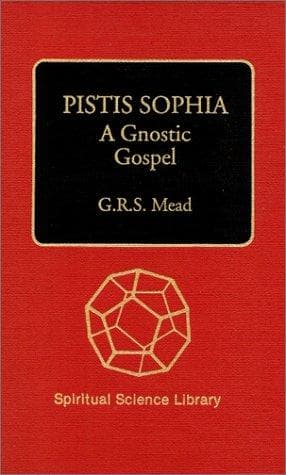
Apocryphal books (New Testament); Christian heresies -- History -- Early church, ca. 30-600; Gnosticism
The opening sentence of the FOURTH DOCUMENT shows plainly that it comes
from a book written independently of the preceding ones and not as their
continuation. It ignores completely the tradition held in the time of
the Antonines by orthodox and heretic alike, that Jesus spent many years
on earth after the Resurrection,[34] and announces that after He “rose
from among the dead the third day,” His disciples gathered round Him
reminding Him that they had left the whole world to follow Him.[35] Then
begins a scene that reminds one irresistibly of the magical practices
rife during the first three centuries of our Era, some details of which
have come down to us in the _Philosophumena_ and in the different Magic
Papyri to be found in the Museums of Paris, London, Leyden, and Berlin.
Jesus, standing by an altar by the side of the sea “Ocean,” makes
invocation to His Father in words which are not gibberish, as at first
sight they appear to be, but a jumble of Hebrew, Egyptian, and perhaps
Persian words copied and re-copied by scribes ignorant of these
languages until they are all but unrecognisable. He calls upon the name
of the Father of the Treasurehouse of Light, whereupon the heavens open
revealing the “true shapes” of the sun and moon, and Jesus and His
disciples are uplifted to “the Middle Way which is below the Sphere.”
Here the arrangement of the stars is explained to them and they learn
that the rebellious Rulers who persisted in copulation were bound to the
Sphere to the number of 1800 for each sign of the Zodiac, under the rule
of 360 of that number, who are themselves under the sway of the five
Planets, Saturn, Mars, Mercury, Venus, and Jupiter. Yet the author of
this Document must have known, although he varies, the tradition of the
First Document, for Jesus tells His hearers that these planets were
strengthened by the infusion into Saturn of a Power from the Great
Unseen God who projected Pistis Sophia, into Mars of a similar Power
from one of the three Triple-powered Gods, into Mercury of one from
another of the Triple Powers, and into Venus of one from “Pistis Sophia
the daughter of Barbelo”[36]; while one from the “Little Sabaoth the
Good,” a Power of higher rank than these last, who in the story of
Pistis Sophia proper is described as supplying the Power which takes the
place of Jesus’ own earthly soul, is cast into the planet Jupiter and is
given rule over all the others. All these planets are given barbarous
names in addition to their Greek ones, as are the Great Unseen God and
the two Triple Powers, these last names appearing also in the Magic
Papyri, while the names of both planets and Powers appear to have a real
meaning.
Public-domain text, read in full here on John Shaqi.
Reviews
Reviews
No reviews yet
Be the first to share your thoughts on this work.
Join the Discussion
Join the discussion
Sign in to leave a comment or review.
Sign InorCreate an account