Authors, American -- 20th century -- Biography; Mencken, H. L. (Henry Louis), 1880-1956; Nathan, George Jean, 1882-1958
Transcriber’s Note
Italic text displayed as: _italic_
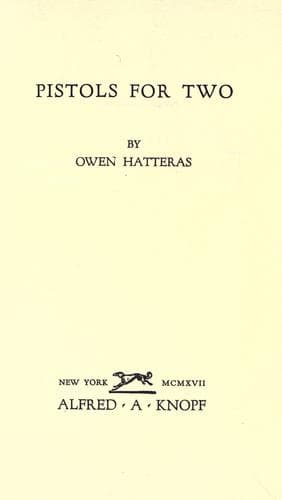
PISTOLS FOR TWO
BY
OWEN HATTERAS
[Illustration: Decoration]
NEW YORK MCMXVII
ALFRED · A · KNOPF
_Published, September, 1917_
PRINTED IN THE UNITED STATES OF AMERICA
CONTENTS
PAGE
GEORGE JEAN NATHAN 5
H. L. MENCKEN 21
PISTOLS FOR TWO
I
Biography fails, like psychology, because it so often mistakes
complexity for illumination. Its aim is to present a complete picture
of a man; its effect is usually to make an impenetrable mystery of
him. The cause of this, it seems to me, lies in the fact that the
biographer always tries to explain him utterly, to account for him in
every detail, to give an unbroken coherence to all his acts and ideas.
The result is a wax dummy, as smooth as glass but as unalive as a dill
pickle.
It is by no such process of exhaustion that we get our notions of
the people we really know. We see them, not as complete images, but
as processions of flashing points. Their personalities, so to speak,
are not revealed brilliantly and in the altogether, but as shy things
that peep out, now and then, from inscrutable swathings, giving us
a hint, a suggestion, a moment of understanding. Does a man really
know what is going on in his wife’s mind? Not if she _has_ a mind.
What he knows is only that infinitesimal part which she reveals,
sometimes deliberately and even truculently, but more often naïvely,
surreptitiously, accidentally. He judges her as a human being, not by
anything approaching entire knowledge of her, but by bold and scattered
inferences. He sees her soul, in so far as he sees it at all, in the
way she buttons her boots, in the way she intrigues for a kiss, in
the way she snaps her eye at him when he has been naughty—interprets
her ego in terms of her taste in ribbons, the scent of her hair, her
quarrels with her sisters, her fashion of eating artichokes, her skill
at home millinery, the débris on her dressing table, her preferences in
the theater, her care of her teeth.
Thus, by slow degrees, he accumulates an image of her—an image changing
incessantly, and never more than half sensed. After long years,
perhaps, he begins to know her after a fashion. That is, he knows how
many shredded wheat biscuits she likes for breakfast, how much of his
business she understands, how long she can read a first-class novel
without napping, what she thinks of woolen underwear, the New Irish
Movement, the family doctor, soft-boiled eggs, and God....
Public-domain text, read in full here on John Shaqi.
Reviews
Reviews
No reviews yet
Be the first to share your thoughts on this work.
Join the Discussion
Join the discussion
Sign in to leave a comment or review.
Sign InorCreate an account