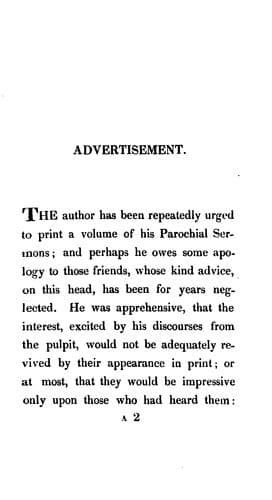
Plain Parochial Sermons, preached in the Parish Church of Bolton-le-MoorsSlade, James
Religion
Plain Parochial Sermons, preached in the Parish Church of Bolton-le-Moors
Slade, James
Episcopal Church -- Sermons; Sermons, English -- 19th century
Again, with respect to a discharge of the ordinary duties of life, there
may be much real, though little seeming difference, in the characters of
many, with whom we are daily acquainted. Punctuality and diligence,
though always commendable and useful for the public good, may be, in as
far as the person himself is concerned, of little value in the sight of
God; our acceptableness with God, in this matter, depends upon the
principle and the view and the spirit, with which the business of life is
conducted: it may be carried on merely for the sake of self-interest; of
gain, reputation, and pleasure; without any religious feeling or purpose
whatever, without a single prayer offered up for heavenly assistance and
blessing, without a word of thanksgiving or acknowledgment: or, on the
other hand, we may proceed to our daily employments and pursuits, “strong
in the Lord and in the power of His might;” imploring and depending upon
His grace; “doing whatever we do for His glory;” active and diligent and
faithful, from a sense of love and duty to Him, for the sake of obeying
the law of our blessed Redeemer, and thus bringing forth the fruit of
faith unto perfection; “living soberly, righteously and godly in this
_present_ world,” {302a} with the continual hope and expectation of a
glorious world to come. Now, whether industry be the work of religious
principle, or whether it arise merely from selfish and earthly views,
_we_ are often unable to decide: but God knoweth all the thoughts of man;
and therefore can assign, to every action and habit and pursuit, its true
origin and its due reward; and many persons, it will be found at last,
who have gone forth together unto their labour, who have been engaged in
the same occupations, have toiled together as companions in life, will be
separated when the day of full inquiry comes; the one, having “sown unto
the spirit,” shall be _taken_ to enjoy the fruit of life everlasting; the
other, having “sown unto the flesh,” shall be _left_ to “reap
corruption.” {302b}
Public-domain text, read in full here on John Shaqi.
Reviews
Reviews
No reviews yet
Be the first to share your thoughts on this work.
Elsewhere in the archive
Join the Discussion
Join the discussion
Sign in to leave a comment or review.
Sign InorCreate an account