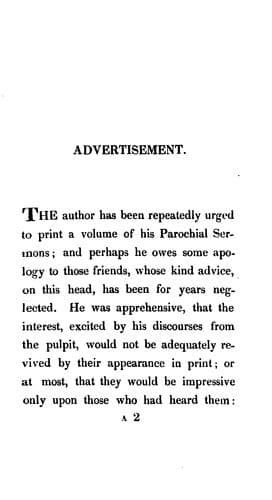
Plain Parochial Sermons, preached in the Parish Church of Bolton-le-MoorsSlade, James
Religion
Plain Parochial Sermons, preached in the Parish Church of Bolton-le-Moors
Slade, James
Episcopal Church -- Sermons; Sermons, English -- 19th century
Similar observations will of course hold good, with regard to the
practice of particular virtues. They, “who give alms only to be seen of
men;” who dispense their bounty from any other principle, than that of
love to their Saviour; for any other purpose, than to serve God and to
benefit their fellow-creatures; they “_have_ their reward” already—the
only reward, which they are caring to seek—the applause, the good will,
or the esteem of mankind: and they must not expect, on the latter day,
the reward which they seek not; the approval of their sovereign Lord; the
praises and blessings of christian charity. Again, they who exercise the
virtues of honesty or sobriety, merely for the sake of worldly expedience
or reputation, will likewise “have their reward” all the reward they are
to expect, in this life. Christian faith and christian principle are the
only foundations, upon which a Christian can surely and successfully
build; they, who build upon them, will be taken to see the goodly fabric
perfected in heaven; whilst every work, which is raised upon “other
foundation,” will be left to desolation and devouring fire.
And even they, who have communed together, through their earthly
pilgrimage, in the bonds of familiar intimacy; who have been united all
their lives long, by the nearest and dearest ties of kindred; even they
will be subject to the same discriminating judgment at the last. If they
have been bound together in the holy bonds of the gospel, as well as of
family affection; if they have been faithful brethren in the Lord, as
well as in the flesh, “walking with God as friends,” it will be well;
then, as they “were lovely and pleasant in their lives, in their deaths
they shall not be divided:” {304} together shall they go to heaven, and
be admitted to enjoy a more delightful communion with each other, in the
happy paradise above. But if it be otherwise, if such friends be of
opposite characters; the one “carnally” the other “spiritually minded;”
then, their ends must be opposite also; “death” is the portion of one,
“life and peace” {305a} of the other: their union therefore must be
dissolved. The world may regard all the members of a family, as nearly
alike in character; but the difference may nevertheless be great; and the
distinction, in another world, will be great also. The wicked parent
shall see its innocent offspring no more; the pious father shall not
deliver the undutiful child, nor the obedient child its rebellious
father; {305b} each can save but his own soul. How feelingly and
powerfully does this consideration appeal to christian families;
admonishing them, to regard not the present only, but the everlasting
welfare of each other; to “edify one another” in holiness and godly love;
lest, after they have been so intimately connected together upon earth,
while the one is taken to felicity and glory, the other be left to
“mourning, lamentation and woe.”
Public-domain text, read in full here on John Shaqi.
Reviews
Reviews
No reviews yet
Be the first to share your thoughts on this work.
Elsewhere in the archive
Join the Discussion
Join the discussion
Sign in to leave a comment or review.
Sign InorCreate an account