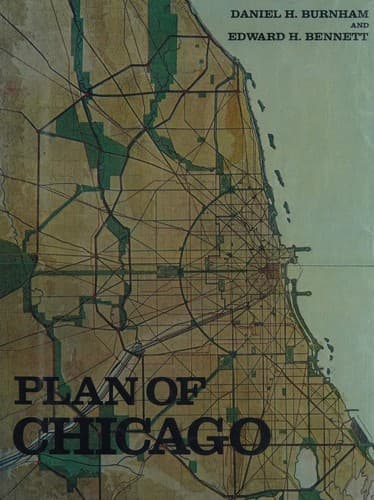
City planning -- Illinois -- Chicago -- History -- 20th century
We have now considered with some detail the disposition of the
streets and avenues surrounding the intense business center of
Chicago. While this outer city area is occupied mainly by dwellings,
certain streets along which transportation lines pass, come to be
lined with shops throughout their entire length, so that one passes
from the center of affairs into the residence district without noting
the transition. As a rule, however, the density and importance of
the buildings decrease from the center to the circumference; and in
corresponding manner the highways of circulation and exchange may
diminish in width. It is essential, however, to provide encircling
or belt thoroughfares which act as collectors of traffic, and also
as distributors of it; so as to prevent the inextricable congestion
which inevitably arises when masses of people gathered along
converging lines attempt to penetrate the center at a single point.
However difficult it may be to provide against such congestion in
the case of older cities, a reasonable system of circulation in
connection with the business center of a comparatively new city like
Chicago should be accomplished with comparative ease. The widening
of some streets and the construction of needed arteries is made less
difficult by reason of the fact that the buildings which cover the
greater part of Chicago’s area beyond the business center are not of
a permanent character, and in the natural order of things they must
be replaced by others more substantial. Provision should be made now
so as to ensure that, as the transformation progresses, sufficient
land area shall be left unoccupied to provide good sanitary
conditions, and attractive streets as well.
The three requisites for this outer region, therefore, are: first,
convenient means of access to the main business center and to the
subordinate centers, which are the day’s working-places; secondly,
equally convenient means of access to the water and the fields and
forests, where the hours of recreation and refreshment are passed;
and, thirdly, as much light and air as possible for the dwellings and
the schools, where the home-keepers are occupied with their daily
tasks, and where the children are trained, either for weakness or for
strength, as physical conditions largely determine.
[Illustration: CVIII. CHICAGO. VIEW OF THE SOUTH SHORE LOOKING SOUTH
EAST OVER GRANT PARK.]
FOOTNOTES:
Public-domain text, read in full here on John Shaqi.
Reviews
Reviews
No reviews yet
Be the first to share your thoughts on this work.
Elsewhere in the archive
Join the Discussion
Join the discussion
Sign in to leave a comment or review.
Sign InorCreate an account