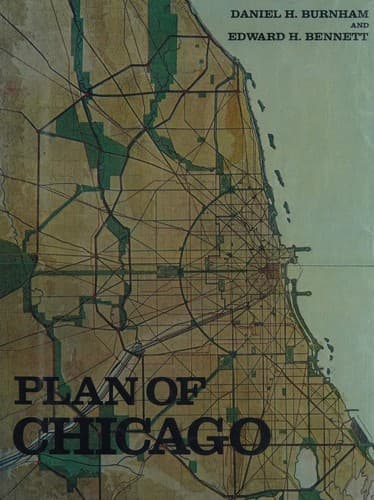
City planning -- Illinois -- Chicago -- History -- 20th century
From Twelfth Street to Chicago Avenue the only east-and-west streets
crossing Michigan Avenue that carry a heavy commercial traffic are
the four east-and-west streets immediately south of the river, and
the four east-and-west streets immediately north of the river.
These eight east-and-west streets, together with the tracks and
sidings of the Chicago and Northwestern railway on the north bank
of the river, are the only points where commercial traffic comes
into collision with the north-and-south movement on the Lake front
parkway. Naturally the commercial cross-traffic that flows east and
west through these eight streets is particularly dense, being created
by the railway terminals, docks, and warehouses east of Michigan
Avenue, both north and south of the river. By actual count on a
given day it was found that between the hours of 8 and 10 o’clock in
the morning the pedestrian movement at the crowded crossing at the
intersection of Michigan Avenue with Randolph Street was 12,484. In
short, 104 people, sixty per cent of whom were probably women and
children, passed this corner every minute. On the same morning it
was ascertained that between 7 and 10 o’clock 893 trucks and light
vehicles moved in the intersection of one of these streets and
Michigan Avenue. Confusion and delay attendant upon the concentration
of such masses are certain to increase as the Illinois Central, the
Michigan Central, and the Wisconsin Central railways improve their
terminals, as the warehouses of this district are increased, and as
more docks or harbors are developed at the mouth of the river.
By the plan for the connecting boulevard, which would begin its rise
at Randolph Street, heavy traffic would be diverted into Lake Street
and other streets north, making the Randolph Street intersection
safer for pedestrian movement. The other streets crossing under the
parkway would be freed almost entirely of cross-traffic, and the
loss of time resulting from impeded movement would be reduced to the
minimum.
Evidently if this Lake front parkway is to be dedicated solely to
the use of the people, with commercial traffic excluded, it cannot
be carried across these east-and-west streets at the present level
of Michigan Avenue, without depressing these east-and-west streets.
After an investigation by engineers all thought of such street
depression has been abandoned. Therefore the boulevard connection
must be elevated from Randolph Street on the south to Indiana Street
on the north, if collision between two classes of traffic, both of
which are better served when kept apart, is to be avoided.
Public-domain text, read in full here on John Shaqi.
Reviews
Reviews
No reviews yet
Be the first to share your thoughts on this work.
Elsewhere in the archive
Join the Discussion
Join the discussion
Sign in to leave a comment or review.
Sign InorCreate an account