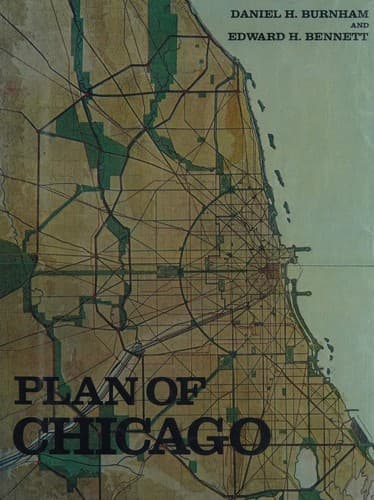
City planning -- Illinois -- Chicago -- History -- 20th century
The civic center will be dependent for its effectiveness on the
character of the architecture displayed in the buildings themselves,
in their harmonious relations one with another, and in the amount of
the space in which they are placed. Surely, the results attained at
the World’s Columbian Exposition in 1893 so amply proved the truth of
these principles that it is not necessary to enlarge upon them. The
attainment of harmony, good order, and beauty is not a question of
money cost, for in the end good buildings are far cheaper than bad
buildings. What is required is enlightened understanding and competent
planning; the great buildings of the world are simple and inexpensive
when compared with many of the over elaborate structures of the present
day; but for centuries they have served their important purposes and
the people will not give them up, because they have become part and
parcel of their life. They typify the permanence of the city, they
record its history, and express its aspirations. Such a group of
buildings as Chicago should and may possess would be for all time to
come a distinction to the city. It would be what the Acropolis was
to Athens, or the Forum to Rome, and what St. Mark’s Square is to
Venice,—the very embodiment of civic life. Land should be acquired in
quantity sufficient to carry out a plan commensurate with Chicago’s
needs, and with her dominating position in this region. This plan first
should be worked out by the architects, and then should be realized by
the concerted action of the community.
Important as is the civic center considered by itself, when taken in
connection with this plan of Chicago it becomes the keystone of the
arch. The development of Halsted Street, and Ashland and Michigan
avenues, flanked by the great thoroughfares of Chicago Avenue and
Twelfth Street, will give form to the business center; while the
opening of Congress Street as the great central axis of the city will
at once create coherence in the city plan. Nowhere else on this
continent does there exist so great a possibility combined with such
ease of attainment. Simply by an intelligent handling of the changes
necessary to accommodate the growing business of Chicago, a city both
unified and beautiful will result. The Lake front will be opened to
those who are now shut away from it by lack of adequate approaches;
the great masses of people which daily converge in the now congested
center will be able to come and go quickly and without discomfort;
the intellectual life of the city will be stimulated by institutions
grouped in Grant Park; and in the center of all the varied activities
of Chicago will rise the towering dome of the civic center, vivifying
and unifying the entire composition.
[Illustration: CXL. STUDY FOR THE DOME OF THE PROPOSED CIVIC CENTER.
From a study by F. Janin.
COPYRIGHT, 1909, BY COMMERCIAL CLUB OF CHICAGO ]
FOOTNOTES:
Public-domain text, read in full here on John Shaqi.
Reviews
Reviews
No reviews yet
Be the first to share your thoughts on this work.
Elsewhere in the archive
Join the Discussion
Join the discussion
Sign in to leave a comment or review.
Sign InorCreate an account