City planning -- Illinois -- Chicago -- History -- 20th century
In the exercise of the power of eminent domain, the state may take
private property, but only for a “public use” and only upon payment
of just compensation. No man can, in this country, be required to
surrender his property, even for full value, unless the use for which
it is taken is public. The right assumed by some European governments
to condemn large areas of land in order, by selling part of it, to
defray the cost of improving the rest, would be subject in this country
to the inquiry whether such a purpose is “public,” within the meaning
of that term as expounded by the courts. No judge grounded in the
principles of American jurisprudence would countenance the argument
that mere pecuniary advantage to a municipality could, without other
pretext, justify the taking of private property against the will of the
owner. It is quite another question, however, whether the condemnation
of more land than is directly involved may not be justified as an
incident of a public improvement, when it could not be defended as an
independent speculation.
The last of the three governmental powers mentioned is the power of
taxation. Like the power of eminent domain, it is inherent in every
sovereign state, but no taxes can be levied for other than public
purposes. They may be general, representing the tribute due from every
person to the government which protects him; or special, measured or
limited by the particular benefit accruing to his property from a local
improvement. The cost of public works may be paid for outright from the
proceeds of a single levy or assessment, or may be defrayed from the
proceeds of bonds to be liquidated by annual contributions distributed
over a term of years. The constitution of Illinois requires provision
to be made for paying all municipal bonds within twenty years, and
limits the amount of indebtedness which any municipal body may incur to
five per cent of the assessed value of taxable property therein; but
does not impose any general limitation upon the amount or rate of taxes
which municipal bodies may be authorized to levy.
Such is a brief characterization of the three functions of government
upon which chiefly depends the execution of public enterprises in
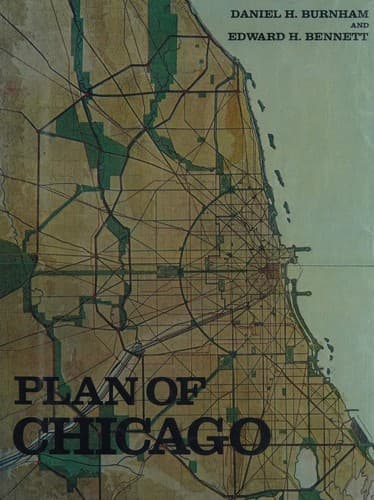
this country. The Plan of Chicago, now under consideration, embraces
as its leading features the acquisition, maintenance, and control
of parks, boulevards and arteries of communication throughout the
metropolitan territory tributary to Chicago; the establishment and
control of similar parks, circuits and avenues within the city itself,
and incidentally the reclamation of slums and congested areas; the
embellishment of the shore of Lake Michigan; the consolidation and
rearrangement of freight and passenger terminals; and the creation of
a Civic Center connected with other parts of the city by convenient
avenues, and in or about which shall be grouped important public
buildings which may hereafter be erected.
OUTER PARKS, BOULEVARDS, AND CIRCUITS
Public-domain text, read in full here on John Shaqi.
Reviews
Reviews
No reviews yet
Be the first to share your thoughts on this work.
Elsewhere in the archive
Join the Discussion
Join the discussion
Sign in to leave a comment or review.
Sign InorCreate an account