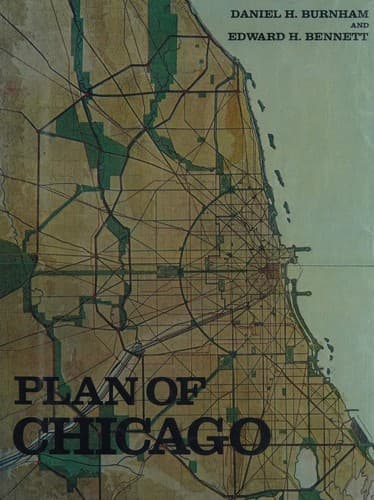
City planning -- Illinois -- Chicago -- History -- 20th century
The Metropolitan Park Commission is a creature of the state—not of
the particular communities directly affected—and over its fortunes
the legislature has maintained a constant fostering care, extending
and defining its jurisdiction by successive acts, and granting fresh
financial powers as occasion arose. Local home rule is a political
principle not so firmly established there as in Illinois. Here it would
not be feasible to create a similar body by legislative fiat without
the concurring vote of the people of the district over which its
jurisdiction extended. Legislation designed for similar ends is more
likely, in this state, to take the general form of enlargement of the
powers and functions of the city and the county; or, especially if more
than one county is involved, of the creation of a special commission
endowed with extraordinary powers and similar in many of its features
to the forest-preserve districts contemplated by the Act approved May
18, 1905.[39]
This measure, which is entitled “An Act to provide for the creation
of forest-preserve districts,” authorizes the incorporation as a
forest-preserve district of any area of contiguous territory containing
one or more cities, towns, or villages within the same or adjoining
counties. Such a district can only be organized by the affirmative vote
of the inhabitants; and if it embraces parts of two counties, there
must be a favorable vote in each. The affairs of the district are to be
managed by a president and six commissioners, appointed by the governor
and drawn from different political parties. The president alone
receives a salary. The board is authorized to accept control of streets
in any city, town, or village on request of the local authorities, and
to designate existing streets and roads as pleasure driveways, and lay
out and establish others for that purpose; but none of these is to be
within any public park district. Power is given to acquire, by gift,
purchase, or condemnation, any land not already in a park district for
driveways and forest preserves. Bonds may be issued to the amount of
one per cent of the assessed value of all property in the district, and
this amount may be increased by a vote of the people to three per cent.
Authority is given to levy taxes for the payment of bonds and interest
thereon, and also to levy for general purposes an additional tax not
exceeding one mill on the dollar.
Public-domain text, read in full here on John Shaqi.
Reviews
Reviews
No reviews yet
Be the first to share your thoughts on this work.
Elsewhere in the archive
Join the Discussion
Join the discussion
Sign in to leave a comment or review.
Sign InorCreate an account