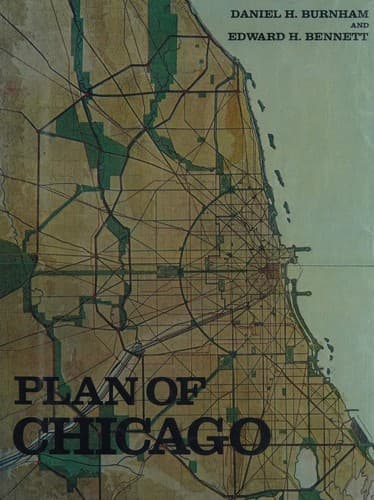
City planning -- Illinois -- Chicago -- History -- 20th century
City councils are empowered by Article V of the City and Village Act of
1872 to lay out, establish, open, widen, pave, and otherwise improve
streets, alleys, avenues, parks, and public grounds, and to plant trees
upon and regulate the use of the same.[43] In the case of _Thompson_
v. _Highland Park_, 187 Ill. 265, the court sustained the power of
the city to include parkways and grass plots in the improvement of a
street to be paid for by special assessment. The special Act of May
18, 1905,[44] relating to the city of Chicago only, confers upon the
council power to acquire, by purchase or otherwise, municipal parks
and playgrounds, and declares that the city may exercise the right of
eminent domain for the acquirement of property useful, advantageous,
or desirable for municipal purposes; and that the procedure in such
cases shall be, as nearly as may be, like that provided for in the
Act of June 14, 1897, concerning local improvements as amended or to
be amended. Land taken for a park is “property useful, advantageous,
or desirable for municipal purposes,” and a public park is a “local
improvement,” the cost of which may be assessed upon contiguous
property to the extent of the special benefits when the legislature
authorizes that course to be pursued.[45] The “Act concerning local
improvements”[46] directs the city council to provide, in any ordinance
for a local improvement, whether it shall be made by special assessment
or special taxation, or by general taxation, or otherwise; and, in
sections 13 to 33, inclusive, defines the procedure for ascertaining
the compensation to be paid for private property taken or damaged,
and for assessing the cost on other property to the extent to which
it is specially benefited. The city, therefore, already possesses
power to acquire public parks within the city limits and to assess
the cost, or the greater part thereof, against property in the
neighborhood of the improvement. Under the present law all ordinances
for local improvements in the city, to be paid for wholly or in part
by special assessment or special taxation, must originate with the
board of local improvements; but if the park boards were merged in the
city government, it might be feasible to grant to an administrative
department of parks the initiative with respect to local improvements
within their special jurisdiction.[47] The city authorities have now
ample power, to the extent of their financial resources, to improve
and widen existing streets and to open new streets, parks and public
grounds. The city council has adequate discretion to determine how wide
any street shall be, and whether it shall be devoted entirely to travel
or given up partly to lawns, trees, and parkways.
Public-domain text, read in full here on John Shaqi.
Reviews
Reviews
No reviews yet
Be the first to share your thoughts on this work.
Elsewhere in the archive
Join the Discussion
Join the discussion
Sign in to leave a comment or review.
Sign InorCreate an account