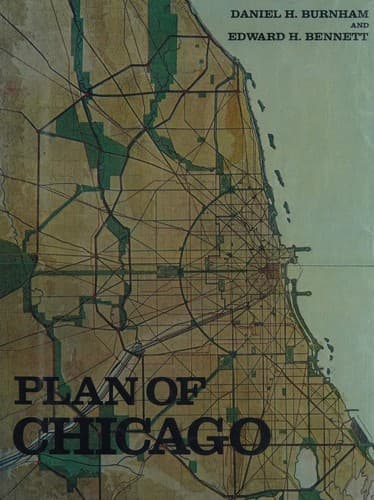
City planning -- Illinois -- Chicago -- History -- 20th century
The right of the state to authorize structures which might interfere
with navigation is subordinate to the paramount control of the War
Department of the United States; and the improvements contemplated
by the legislation last described cannot be carried out without the
consent of the Secretary of War. Proceedings looking to a grant of
such consent were temporarily stayed by the remonstrance of Mayor
Busse, and the appointment by him, under authority of the city council,
of the Chicago Harbor Commission, which has made a comprehensive
study and detailed report on the harbors of the city, together with
recommendations as to harbor, railway terminal, and park plans along
that part of the shore of Lake Michigan between Twelfth Street and
Jackson Park. The report is entirely favorable to the essential
features of the plan for park and boulevard development on the Lake
Front, but with appropriate reservations for future harbor development.
It strongly favors the accomplishment of such plans at the earliest
possible moment, stating that “there is no real conflict between
the harbor and the park interests of Chicago and no artificial or
unnecessary discord should be permitted to retard the complete and
prompt execution of the plans necessary for the development of both
sides of the city’s life.” It recommends that “a detailed plan carrying
out this idea should be worked out jointly by the experts of the park
authorities and an expert engineer appointed by the city, subject to
the approval of the city council and the South Park Commissioners,” and
urges immediate action by these authorities. As soon as such a plan can
be worked out and the consent of the War Department be secured, there
is nothing but the question of ways and means to delay the execution of
this plan. The legislature has already authorized the South Park board,
upon obtaining authority from the people at an election, to issue bonds
up to the constitutional limit for the construction of the Lake Front
Park.[72]
TRANSPORTATION PROBLEMS
The readjustment of freight and passenger traffic and the relocation
of railroad terminals is a subject which requires little comment from
a legal point of view. When railway companies are brought to the point
of hearty co-operation with the Chicago Plan, the powers which they
already enjoy will be found adequate to the execution of their part.
The state has placed at their service all necessary powers of eminent
domain, and those portions of streets and alleys required for railway
terminals may be vacated by the city. Although the action of the city
council in vacating streets to make room for a railway station has been
attacked, it has been sustained by the lower courts.
Public-domain text, read in full here on John Shaqi.
Reviews
Reviews
No reviews yet
Be the first to share your thoughts on this work.
Elsewhere in the archive
Join the Discussion
Join the discussion
Sign in to leave a comment or review.
Sign InorCreate an account