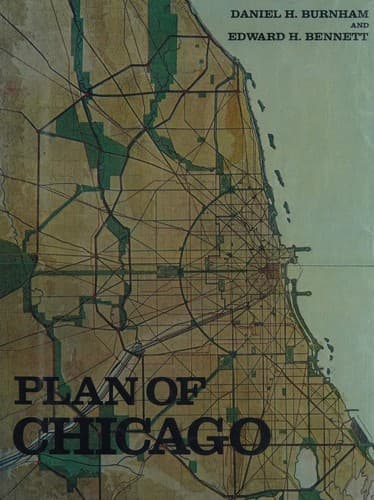
City planning -- Illinois -- Chicago -- History -- 20th century
It may be that the legislature should be asked to confer upon the
city additional powers that would enable it to acquire property for
railway terminals and appropriate connections to be used by the
various transportation lines on just terms. A city cannot condemn
land for the purpose of turning it over to a railway corporation,
but there can be little doubt of the power of the legislature to
authorize a city to condemn land in order to create a central clearing
place for traffic. Chapter 247 of the Acts of the legislature of
Wisconsin for the year 1907 is an example of a law designed for that
end. This statute authorizes cities of the first class to acquire,
establish, own and operate railway terminals, and to condemn land
for that purpose. Having established such a terminal, the city may
permit any railroad corporation to use it upon agreed terms, or, if
the parties cannot agree, then upon terms to be fixed by the state
railroad commission. To meet the first cost, the city is authorized
to issue “railway terminal certificates,” payable only out of the
revenues derived from the terminals for the acquisition of which they
are issued. These certificates may be secured by trust deed, and there
are provisions for foreclosure similar in many respects to those
contained in the so-called “Mueller Law” enacted by the legislature of
Illinois, authorizing municipal ownership of street railways. Under
the decision of the Supreme Court of Illinois,[73] such certificates
would constitute “indebtedness” of the city, and the amount which
could be issued at any time would be controlled by the constitutional
limitation of municipal indebtedness. That municipal certificates or
bonds secured by revenue-producing utilities and not made a charge upon
the other property or general credit of the city should be exempted
from the general constitutional debt limit is advocated by men of
widely different opinions upon the public-utility question,[74] and is
provided in various state constitutions.[75] Constitutional amendments
to this effect are being proposed in New York and elsewhere.
CONTROL OF LANDS ADJACENT TO PUBLIC IMPROVEMENTS
In order to secure the full benefit of a park, boulevard, avenue
or other place of public recreation or resort, some control of the
immediate surroundings is indispensable. The municipal authorities
which establish parks, boulevards, and other public places need some
power to regulate the use of premises within immediate view of the
public grounds, so as to prevent offensive advertising, restrict
the kinds of business, if any, to be conducted thereon, and make
appropriate regulation of the height, manner of construction, and
location of the surrounding buildings. To that end, resort must be had
either to the police power or to the power of eminent domain.
Public-domain text, read in full here on John Shaqi.
Reviews
Reviews
No reviews yet
Be the first to share your thoughts on this work.
Elsewhere in the archive
Join the Discussion
Join the discussion
Sign in to leave a comment or review.
Sign InorCreate an account