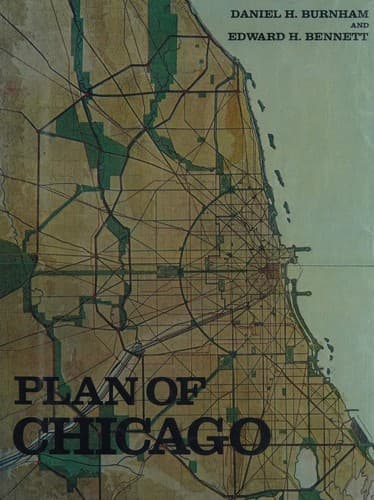
City planning -- Illinois -- Chicago -- History -- 20th century
The construction of buildings is also subject to some regulation under
the police power. The city is vested with authority to prescribe the
strength and manner of constructing buildings, to define fire limits,
and to pass and enforce all necessary police ordinances; and the
power conferred upon it to pass “all necessary police ordinances” is
construed as delegating to the city all the appropriate police power of
the state.[77] No question is made but that the city council has power
to regulate the height of buildings with a view to health and public
safety; but it may be doubted whether the police power would justify
the municipal authorities in imposing more rigorous restrictions upon
the character of buildings to be constructed along boulevards and
around parks than in other parts of the city. The Supreme Judicial
Court of Massachusetts has sustained the right of the legislature to
delegate to a city the power to regulate the height of buildings, to
prescribe different regulations for different districts, and to invest
a commission with the right to determine the boundaries between such
districts,[78] and has expressed the opinion that certain special
regulations of the height of buildings around a public square might
be imposed under the police power without making compensation.[79]
It is doubtful whether local distinctions of this character would be
sustained in Chicago under existing legislation, except in so far as
they might be justified by the power to establish fire limits. The
legislature might delegate to city councils the power to district the
city and prescribe different building limits in different districts;
but any distinctions of this sort would have to rest upon real
differences, and it remains doubtful whether the police power could be
invoked to justify making a special district of the area surrounding
a public square or avenue. The council could not be invested with
authority to establish building lines without awarding compensation to
the owner;[80] nor could the legislature confer the right to regulate
arbitrarily the character of the business to be conducted in premises
abutting on a boulevard.[81] A business which is an actual nuisance
may be prohibited altogether; and the legal machinery exists for
excluding saloons and some other kinds of business from limited areas.
Such exercise of the police power must, however, bear some reasonable
relation to the public health, safety, or morals, and could not, under
existing constitutional restraints, be extended to business in general.
Public-domain text, read in full here on John Shaqi.
Reviews
Reviews
No reviews yet
Be the first to share your thoughts on this work.
Elsewhere in the archive
Join the Discussion
Join the discussion
Sign in to leave a comment or review.
Sign InorCreate an account