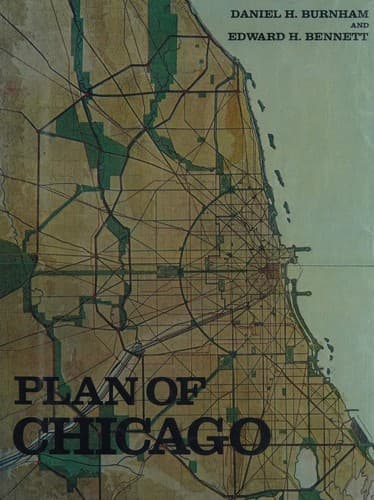
City planning -- Illinois -- Chicago -- History -- 20th century
Such being the limits of the police power, it is evident that, in
order to secure any effective control of the environs of a public
place, resort must be had to some authority of wider scope, and the
only available power is that of eminent domain, under which the state
and its agencies have the right to take any private property for a
public use, upon providing just compensation. The areas adjacent to a
public place could probably be controlled under this power, either by
condemning them outright as a part of the improvement, or by condemning
merely a qualified right to regulate and control them. If they were
taken outright, the question would arise whether they could be resold
subject to the necessary restrictions upon their future use; thus
reducing the cost of the improvement to the extent of the increase in
the value of this land caused by the improvement.
The right to appropriate private property for public use is an
attribute of sovereignty, existing in the state independently of
written constitutions, and vested in the general assembly by those
provisions of the constitution which confer upon that body the
legislative power of the state. In Illinois, as in all of the states,
the power of the legislature to take private property for the use of
the community is subject to two constitutional limitations: one, that
just compensation must be provided for all property so taken; the
other, that private property cannot be taken, even upon payment of its
full value, for any except a public use. These two restrictions are
also imposed by the fourteenth amendment of the federal constitution,
which declares that no state shall deprive any person of property
without due process of law. Subject to these qualifications, the state
has unlimited power to appropriate through its legislature any property
within its borders which has become the subject of private ownership;
and this power of eminent domain the legislature may delegate, with or
without restrictions, to any subordinate agency. The expediency of the
exercise of that power in any given case is a subject over which the
courts have no control, unless they can say that the proposed use is
not public. On these general principles all the authorities are agreed.
The United States Supreme Court has frequently stated the principles of
the law of eminent domain. In _Boom Company_ v. _Patterson_, 98 U. S.
403, Mr. Justice Field, in delivering the opinion of the court, said:
Public-domain text, read in full here on John Shaqi.
Reviews
Reviews
No reviews yet
Be the first to share your thoughts on this work.
Elsewhere in the archive
Join the Discussion
Join the discussion
Sign in to leave a comment or review.
Sign InorCreate an account