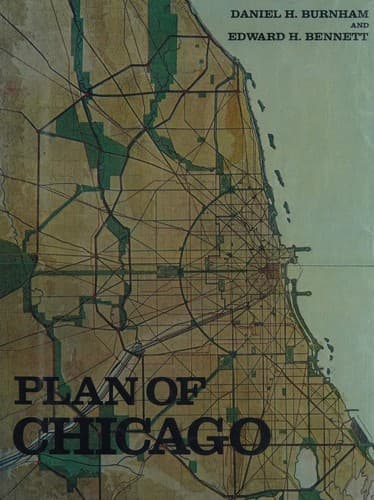
City planning -- Illinois -- Chicago -- History -- 20th century
“In the memory of men now living, a proposition to take private
property, without the consent of its owner, for a public park, and to
assess a proportionate part of the cost upon real estate benefited
thereby, would have been regarded as a novel exercise of legislative
power. It is true that, in the case of many of the older cities and
towns, there were common or public grounds, but the purpose of these
was not to provide places for exercise and recreation, but places on
which the owners of domestic animals might pasture them in common,
and they were generally laid out as part of the original plan of the
town or city. It is said, in Johnson’s Cyclopedia, that the Central
Park of New York was the first place deliberately provided for the
inhabitants of any city or town in the United States for exclusive
use as a pleasure ground for rest and exercise in the open air.
However that may be, there is now scarcely a city of any considerable
size in the entire country that does not have, or has not projected,
such parks. The validity of the legislative acts erecting such parks,
and providing for their cost, has been uniformly upheld.”
Again, in the case of _Attorney General_ v. _Williams_, 174 Mass. 476,
the Supreme Judicial Court of Massachusetts used the following language:
“The uses which should be deemed public in reference to the right of
the legislature to compel an individual to part with his property
for a compensation, and to authorize or direct taxation to pay for
it, are being enlarged and extended with the progress of the people
in education and refinement. Many things which a century ago were
luxuries, or were altogether unknown, have now become necessaries.
It is only within a few years that lands have been taken in this
country for public parks. Now the right to take land for this purpose
is generally recognized and frequently exercised.... The grounds on
which public parks are desired are various. They are to be enjoyed
by the people who use them. They are expected to minister not only
to the grosser senses, but also to the love of the beautiful in
nature, in the varied forms which the changing seasons bring. Their
value is enhanced by such touches of art as help to produce pleasing
and satisfactory effects on the emotional and spiritual side of our
nature. Their influence should be uplifting, and, in the highest
sense, educational. If wisely planned and properly cared for, they
promote the mental as well as the physical health of the people. For
this reason it has always been deemed proper to expend money in the
care and adornment of them, to make them beautiful and enjoyable.
Their æsthetic effect never has been thought unworthy of careful
consideration by those best qualified to appreciate it. It hardly
would be contended that the same reasons which justify the taking of
land for a public park do not also justify the expenditure of money
Public-domain text, read in full here on John Shaqi.
Reviews
Reviews
No reviews yet
Be the first to share your thoughts on this work.
Elsewhere in the archive
Join the Discussion
Join the discussion
Sign in to leave a comment or review.
Sign InorCreate an account