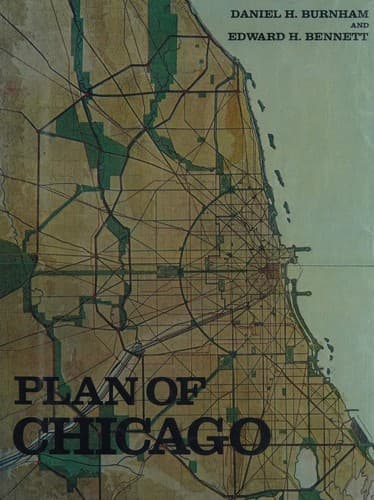
City planning -- Illinois -- Chicago -- History -- 20th century
to make the park attractive and educational to those whose tastes are
being formed, and whose love of beauty is being cultivated.”
When once it is conceded that a use is public, the courts have no
control over the character of the estate or easement to be taken for
the purpose. The constitution of Illinois provides, indeed, that when
a railroad company condemns a right-of-way the fee shall remain in the
former owner; but, subject to that restriction as to these particular
corporations, the legislature has unlimited power to specify the
nature, extent, and duration of the estate that shall be taken for any
public use. Having the right to authorize the taking of an absolute
title, it could direct the appropriation of any lesser interest, and
could confer upon public bodies power to condemn the right to restrict
the use and improvement of property contiguous to public grounds.
It does not appear, however, that the present statutes of Illinois
do confer upon municipalities any express power to condemn such
easements over lands contiguous to a street, boulevard, park or other
public place. In the legislation under which the West Chicago Park
Commissioners were incorporated and organized, there were sections
expressly directing the park commissioners to impose building lines
upon property adjacent to the parks and boulevards authorized thereby,
and in the condemnation proceedings compensation was to be included for
this burden. The West Park board, however, never undertook to avail
itself of these extensive powers, which were limited to the acquisition
of the original parks and boulevards authorized by the act. It might
be argued that the city, under its present authority to establish and
enlarge parks, boulevards, and streets, could condemn such easements
directly, or that it could condemn a wide strip for a new street or
land contiguous to an old street, and, by the familiar device of a
stipulation entered of record in the condemnation suit, limit the
appropriation to a restricted control of the use of the property.
The latter method, if lawful, would be clumsy and inadequate, and
additional legislation would be desirable to enable public authorities
effectively to acquire, under the power of eminent domain, a qualified
jurisdiction or control over property of which the exclusive use is not
taken.
Public-domain text, read in full here on John Shaqi.
Reviews
Reviews
No reviews yet
Be the first to share your thoughts on this work.
Elsewhere in the archive
Join the Discussion
Join the discussion
Sign in to leave a comment or review.
Sign InorCreate an account