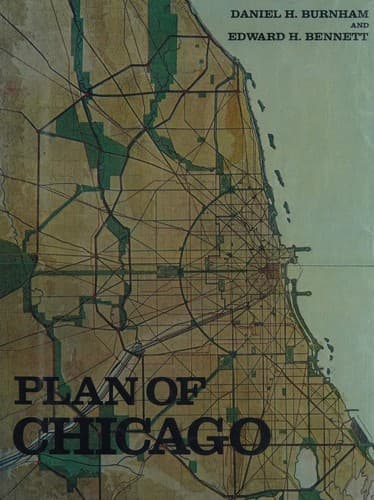
City planning -- Illinois -- Chicago -- History -- 20th century
An instructive case bearing upon this argument is that of _Dingley_ v.
_Boston_, 100 Mass. 544. For the purpose of draining and grading up a
part of the Back Bay district, the Massachusetts legislature authorized
the city of Boston to take land within a certain area, and provided
that the title should vest in the city. The contemplated use, although
extensive, was merely temporary; when the land was filled and the
surface raised to a higher grade, the purpose for which it was taken
would have been accomplished. The Supreme Court, nevertheless, holds
that it was the object of the statute to authorize the taking of a fee
simple absolute, and that after the filling had been completed the
title remained in the city, subject to such use or disposition as the
authorities might deem expedient. The use being public, it could not be
said that the taking of a fee simple was any the less for public use
than the taking of a smaller estate would have been; the legislature
was sole judge of the expediency of taking one or the other. The court
speaks as follows:
“The act provides that the city government may first take the land,
and thereby transfer to the city a title in fee simple, without the
consent of the owners. It is contended that, as the only object of
the act is to abate a nuisance, the act ought only to have granted
the power to occupy the land temporarily until the object of the act
should be effected, and it should then be restored to the owners,
with a provision that the benefit done to the land should be applied
in offset to the damages. It is true that the raising of the grade
does not require an occupation of the land for a great length of
time. When this work is completed the nuisance will be abated, and
the land will be in a condition to be occupied by private persons.
But its condition will be greatly changed; almost as much so as
raising flats into upland. The former surface will be deeply buried
under the earth that will have been brought upon it, and the changed
condition is to be perpetual. If the old property is restored, the
new property which has been annexed to it must go with it. This
would be very unjust to the city, who have been compelled to incur
the great expense of destroying the nuisance, unless the owner were
required to make a reasonable compensation, which might be far beyond
the amount of the damages to which he would be entitled.
Public-domain text, read in full here on John Shaqi.
Reviews
Reviews
No reviews yet
Be the first to share your thoughts on this work.
Elsewhere in the archive
Join the Discussion
Join the discussion
Sign in to leave a comment or review.
Sign InorCreate an account