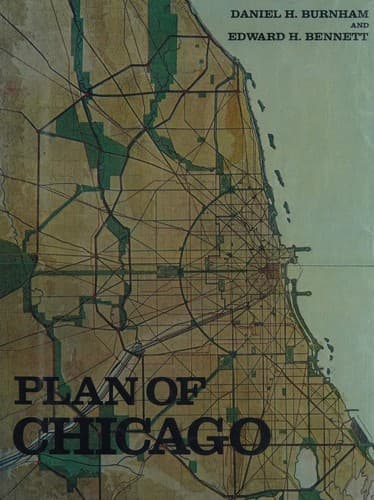
City planning -- Illinois -- Chicago -- History -- 20th century
If any local legislation authorizing the condemnation and sale of
surplus lands were brought to the test, the question for the courts
would be whether the use for which the property was taken was a public
one; and it must be borne in mind that upon this point the judgment
of the Supreme Court of a state would not be final. By the Fourteenth
Amendment to the Constitution of the United States it is provided that
no state shall deprive any person of property without due process of
law; and it is now settled that this clause prohibits the taking of
private property for any use that is not public. The United States
Supreme Court, however, has always paid the greatest deference to the
opinions of state legislatures and the state judiciary as to what uses
are public. The power of the United States Supreme Court to review
a state decision in this particular, and also the extreme respect
which will be paid to local decisions, are both well illustrated in
the case of _Clark_ v. _Nash_, 198 U. S. 361, sustaining a statute of
the state of Utah, by the terms of which an individual land owner was
empowered to condemn the right of conveying water in a ditch across his
neighbor’s land for the purpose of irrigating his own farm. Mr. Justice
Peckham, delivering the opinion of the court, said:
“In some states, probably in most of them, the proposition contended
for by the plaintiffs in error would be sound. But whether a statute
of a state permitting condemnation by an individual for the purpose
of obtaining water for his land or for mining should be held to be
a condemnation for a public use, and therefore a valid enactment,
may depend upon a number of considerations relating to the situation
of the state and its possibilities for land cultivation, or the
successful prosecution of its mining or other industries. Where the
use is asserted to be public, and the right of the individual to
condemn land for the purpose of exercising such use is founded upon
or is the result of some peculiar condition of the soil or climate,
or other peculiarity of the state, where the right of condemnation is
asserted under a state statute, we are always, where it can fairly
be done, strongly inclined to hold with the state courts, when they
uphold a state statute providing for such condemnation. * * *
Public-domain text, read in full here on John Shaqi.
Reviews
Reviews
No reviews yet
Be the first to share your thoughts on this work.
Elsewhere in the archive
Join the Discussion
Join the discussion
Sign in to leave a comment or review.
Sign InorCreate an account