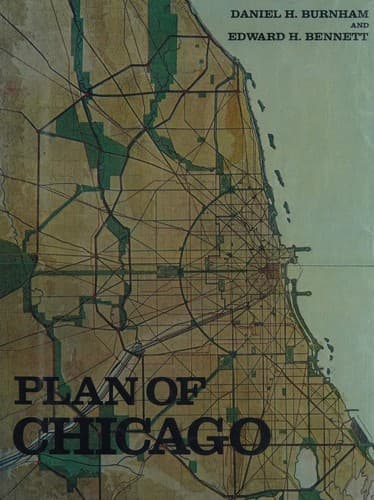
City planning -- Illinois -- Chicago -- History -- 20th century
“We do not desire to be understood by this decision as approving of
the broad proposition that private property may be taken in all cases
where the taking may promote the public interest and tend to develop
the natural resources of the state. We simply say that in this
particular case, and upon the facts stated in the findings of the
court, and having reference to the conditions already stated, we are
of the opinion that the use is a public one, although the taking of
the right of way is for the purpose simply of thereby obtaining the
water for an individual, where it is absolutely necessary to enable
him to make any use whatever of his land, and which will be valuable
and fertile only if water can be obtained.”
Again, in the very recent case of _Hairston_ v. _Danville & Western
Railway Co._, 208 U. S. 598, the facts were that the Supreme Court of
Virginia had sustained a proceeding by which a railroad condemned land
for a spur track to a tobacco factory, the owner of which agreed to
reimburse the company for the cost of acquiring the land. The decision
of the federal court sustaining the judgment of the state court was
delivered by Mr. Justice Moody, who said:
“When we come to inquire what are public uses for which the right
of compulsory taking may be employed, and what are private uses
for which the right is forbidden, we find no agreement, either in
reasoning or conclusion. The one and only principle in which all
courts seem to agree is that the nature of the uses, whether public
or private, is ultimately a judicial question. The determination of
this question by the courts has been influenced in the different
states by considerations touching the resources, the capacity of
the soil, the relative importance of industries to the general
public welfare, and the long-established methods and habits of the
people. In all these respects, conditions vary so much in the states
and territories of the Union that different results might well be
expected.... No case is recalled where this court has condemned as a
violation of the Fourteenth Amendment a taking upheld by the state
court as a taking for public uses in conformity with its laws.... We
must not be understood as saying that cases may not arise where this
court would decline to follow the state courts in their determination
of the uses for which land could be taken by the right of eminent
domain. The cases cited, however, show how greatly we have deferred
to the opinions of the state courts on this subject, which so closely
concerns the welfare of their people. We have found nothing in the
Federal Constitution which prevents the condemnation by one person
for his individual use of a right of way over the land of another
for the construction of an irrigation ditch; of a right of way over
the land of another for an aerial bucket line; or of the right to
flow the land of another by the erection of a dam. It remains for
Public-domain text, read in full here on John Shaqi.
Reviews
Reviews
No reviews yet
Be the first to share your thoughts on this work.
Elsewhere in the archive
Join the Discussion
Join the discussion
Sign in to leave a comment or review.
Sign InorCreate an account