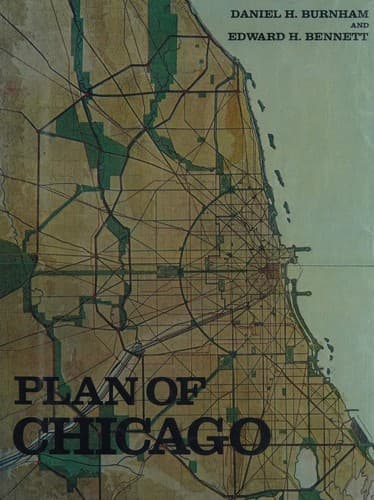
City planning -- Illinois -- Chicago -- History -- 20th century
In Massachusetts, Section 4 of Chapter 50 of the revised laws provides
that the owner of abutting land liable to assessment may at a certain
stage of the proceedings give notice that he elects to surrender his
land; in which event the board may, if it thinks expedient, take the
whole parcel at its estimated value, and any part not required may
be sold. A somewhat similar statute, authorizing an owner to convey
to the city his entire property at its appraised value when part of
it was taken for widening a street, was involved, and by implication
sustained, in the case of _Dorgan_ v. _Boston_, 12 Allen, 223.
Chapter 443 of the Massachusetts laws of 1904 sanctions the taking of
remnants of parcels part of which are condemned for public improvement,
and authorizes the city to sell any of such remnants subject to any
building or other restrictions which the proper authorities may see
fit to impose. The power to take the whole of a tract when part only
is needed is limited to the case where the remnant after such taking
would, from its size or shape, be unsuited for the erection of suitable
and appropriate buildings, and where also the public convenience and
necessity require such taking. There are provisions authorizing such
remnants to be sold and united with adjacent property if the owner
thereof consents; but the legislature refused to adopt the more radical
plan, recommended by a committee, of uniting such remnants with the
contiguous property, without the consent of the owner thereof, by
condemning his land in order to incorporate the remnant with it and
thus effect an advantageous sale. This act has never been tested in
the courts, and it may be surmised that, in spite of the very liberal
views of the Massachusetts courts, the fate of a proceeding under its
provisions would be problematical, unless it could be made to appear
that the “public convenience and necessity” actually did require
such taking of entire tracts for the purpose of imposing upon the
odd remnants some conditions and restrictions germane to the major
improvement.
Another statute, framed on somewhat similar lines, but also never
submitted to a judicial test, is Section 10 of the Ohio Municipal
Code, as amended in 1904. This section provides that all municipal
corporations shall have power to appropriate real estate within their
corporate limits for certain specific purposes, among which are the
following:
“For establishing esplanades, boulevards, parkways, park grounds
and public reservations in, around and leading to public buildings,
and for the purpose of reselling such land, with reservations in
the deeds of such resale as to the future use of said lands so as
so protect public buildings and their environs, and to preserve
the view, appearance, light, air and usefulness of public grounds
occupied by public buildings and esplanades and parkways leading
thereto.”
Public-domain text, read in full here on John Shaqi.
Reviews
Reviews
No reviews yet
Be the first to share your thoughts on this work.
Elsewhere in the archive
Join the Discussion
Join the discussion
Sign in to leave a comment or review.
Sign InorCreate an account