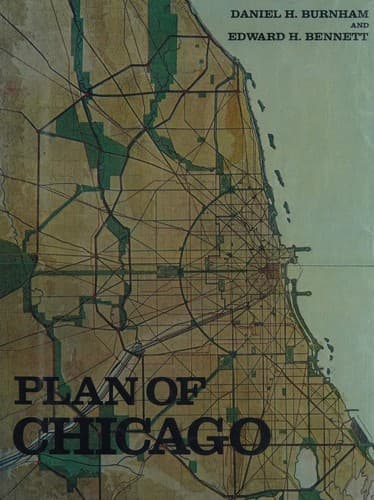
City planning -- Illinois -- Chicago -- History -- 20th century
has been created by the fault of men, an innocent victim of their
malfeasance would have some reason and more law on his side if he
insisted upon the state proceeding against the culprits singly.
Accordingly, the Chicago Plan deals only incidentally with this
subject. The city can, as has been done in some European capitals,
open wide thoroughfares and avenues through congested areas, or take
the heart of the district for a public park; and the legislature might
authorize the condemnation of a zone of reasonable width around these
open spaces on the principles already laid down. It may be doubted,
however, whether the courts would sustain as constitutional a statute
designed to appropriate a whole congested area merely for the purpose
of renovating it. If the power to do so in a flagrant case were
sustained by the Supreme Court of the state, or if such a project were
authorized by constitutional amendment, the measure would probably not
be condemned by the federal courts as contravening the Constitution of
the United States. To the opening of wide streets, however, through
congested districts, as proposed in the Plan, there is no obstacle
unless it be the lack of financial resources.
PRESENT BORROWING AND TAXING POWERS
In carrying out so comprehensive a scheme of development as is
outlined in the Plan of Chicago, some subsidiary sources of revenue
may be found, but the main dependence must be upon the taxing power
of the state and its agencies. Current expenses are properly met by
current taxes; but it is a main principle of economics that the cost
of permanent improvements should be distributed over a series of
years commensurate with the probable duration of the benefit. Lest,
however, the existing generation should lay inordinate burdens upon
posterity, limitations have been set upon the amount and duration of
indebtedness which may be incurred by any municipal body. Section 12
of Article IX of the constitution of the State of Illinois declares
that no municipal corporation shall become indebted for any purpose to
an amount exceeding five per cent of the value of the taxable property
therein, as ascertained by the last assessment; and that, at or before
the time of incurring such debt, the municipality shall provide for
the collection of a direct annual tax sufficient to pay the interest
and to discharge the principal within twenty years from the time when
the debt was contracted. Under the present revenue laws applicable to
Cook County, all taxable property is valued by assessors at its “full
value,” and one-fifth of that figure is entered in the books as the
“assessed value,” and, as afterwards equalized, is made the basis on
which all tax and debt limitations are computed.[89]
Public-domain text, read in full here on John Shaqi.
Reviews
Reviews
No reviews yet
Be the first to share your thoughts on this work.
Elsewhere in the archive
Join the Discussion
Join the discussion
Sign in to leave a comment or review.
Sign InorCreate an account