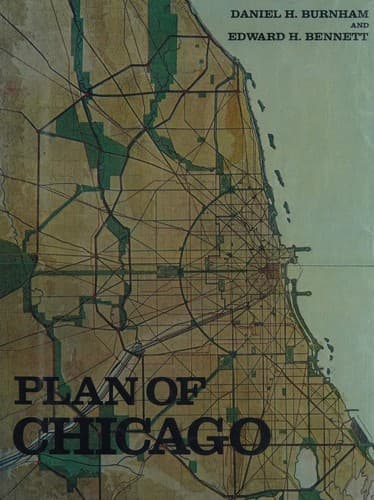
City planning -- Illinois -- Chicago -- History -- 20th century
The city of Chicago is practically indebted at all times to the
constitutional limit of five per cent of its assessed valuation, and
has been given power by the legislature to levy an annual tax for
corporate purposes not exceeding two per cent on that valuation,
exclusive of taxes levied for the payment of bonds. Under the
operation of the Juul law, the maximum rate has been cut down to one
and eight-tenths per cent. The assessed valuation of city property
for 1908 was $477,190,399. A two per cent tax on that amount is
$9,543,808, and a five per cent indebtedness would be $23,859,520. The
legislature could authorize a higher annual tax, but could not, under
the constitution, increase the limit of indebtedness unless by means
of some change in the method of assessing the property on which the
limitation was to be computed.[92] One of the chief reasons for asking
a new charter was to increase the bond-issuing power of the city by
changing the basis of computation of the limit of indebtedness.
The taxing powers of the three park districts in the city of Chicago
are contained in a mass of separate laws, which authorize the issuing
of bonds for particular purposes and the levying of taxes to pay
the interest and retire the principal. The park boards could be
authorized by the legislature to incur debts somewhat in excess of
their present bonded liability, without infringing the provisions of
the constitution; but here also the tax limitations of the Juul law
would have to be modified unless maintenance expenditures were scaled.
The assessed valuation for the year 1908 of property in the West Park
district was $105,614,809, of which five per cent is $5,280,740. The
present bonded debt of the West Park board is $3,270,000, leaving a
possible margin of about $2,000,000 of additional indebtedness that the
legislature could authorize to be incurred by the board.
An entirely new taxing body could, with the consent of the voters, be
created by the legislature, having jurisdiction over all or part of
Cook County. That body, if properly constituted, could be invested with
power to levy such taxes as might be deemed advisable, and with power
to issue bonds up to the constitutional limit of five per cent of the
assessed valuation. It is also to be borne in mind that by some slight
changes in the method of fixing the assessed valuation of property,
which is now arbitrarily defined as one-fifth of the full valuation,
the legislature could largely increase the borrowing power of all the
taxing bodies.
Public-domain text, read in full here on John Shaqi.
Reviews
Reviews
No reviews yet
Be the first to share your thoughts on this work.
Elsewhere in the archive
Join the Discussion
Join the discussion
Sign in to leave a comment or review.
Sign InorCreate an account