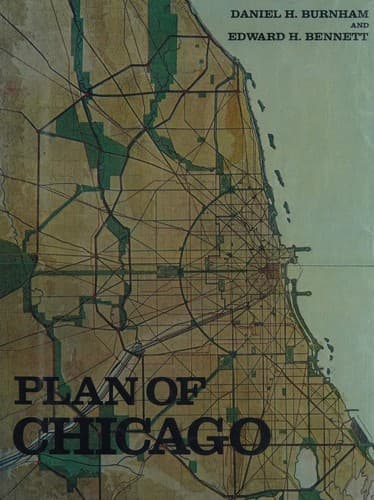
City planning -- Illinois -- Chicago -- History -- 20th century
Large improvements need not only extensive borrowing powers, but the
distribution of the burden over a long series of years. While twenty
years has been heretofore deemed the limit of time which ought to be
allowed for paying any debt incurred by the issue of bonds, it may be
thought that the radical changes contemplated by the Plan of Chicago
are of such unusual magnitude and of such permanent character that
justice might demand distribution of the burden over more than one
generation. Upon that view, bonds running for a longer period might be
thought reasonable. The present constitutional limit of twenty years
is, however, absolute, and an amendment to the constitution would be
required to enable any municipality to issue bonds for a longer term.
CONCLUSIONS
From the foregoing examination of the legal aspects of the Plan of
Chicago it appears
First: That without any additional legislation many of the
recommendations of the Plan can be adopted and practical steps be taken
to carry them into effect;
Second: That the legislature has ample power to grant either to the
city or to other governmental agencies such additional authority as may
be necessary to carry out all of the recommendations of the Plan as
fully and as rapidly as may be found wise; and
Third: That additional authority, and especially a substantial
increase in the local bonding power, is essential to the effective
accomplishment of the most important of these recommendations.
It remains for the people of Chicago, through their legally constituted
representatives, to decide upon the wisdom of the suggestions and to
adopt them in the order of their relative importance and availability.
The necessary funds can no doubt be secured as rapidly as it can be
clearly shown that their expenditure will result in real advantage to
the individual citizens who constitute “the public,” and upon whom
rests, directly or indirectly, the burden of expense. In the last
analysis it must be clear that a community which makes wise expenditure
for public works not only imposes no real burden upon private property,
but increases the value of all private property within its limits. Such
a community should be given adequate authority to levy taxes and incur
debt, subject always to such intelligent supervision of expenditures
as will effectively guard against extravagance and waste. Certainly,
any limitations upon a progressive municipality should be broad enough
to make it possible to undertake such public enterprises as are
recommended in this Plan.
Public-domain text, read in full here on John Shaqi.
Reviews
Reviews
No reviews yet
Be the first to share your thoughts on this work.
Elsewhere in the archive
Join the Discussion
Join the discussion
Sign in to leave a comment or review.
Sign InorCreate an account