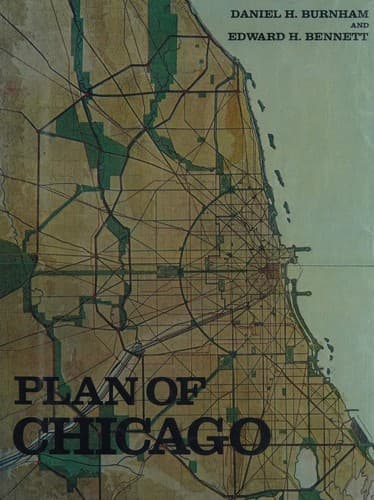
City planning -- Illinois -- Chicago -- History -- 20th century
From earliest times, two motives have governed the location of cities:
either the site was selected because it offered natural means of
defense, or else commerce gathered men at a particular point, about
which they built fortifications. In either case, the necessity of
protection against enemies from without conditioned the form and
arrangement of the city. Even in this western hemisphere the question
of defense has been of moment. Louisburg and Quebec; Boston, New York,
and Yorktown; Mackinac and New Orleans; Charleston, Mobile, Vicksburg,
and New Orleans again,—are names which recall sieges and battles of
three wars; while the walled towns of Europe find their counterparts
in the palisaded settlements which sprang up in the Indian country of
North America, Chicago itself being a typical example. It is only
within recent times that the city has been able to extend its borders
free from the restraints imposed by the necessity of warding off a foe.
[Illustration: X. THE ACROPOLIS AT ATHENS.
From a water-color by E. H. Bennett.]
The first city-builder whose exploits are recorded was Semiramis, queen
of Babylon; and although the history of that country, as recorded on
its monuments, fails to mention even the name of this war-like ruler,
we may not disregard the circumstantial accounts given by classical
writers of the greatest commercial city of ancient times. Diodorus
tells us that Semiramis, being of an aspiring spirit and anxious to
excel all her predecessors in glorious actions, set about building a
great city in the province of Babylon. First she had complete plans
prepared by her architects and artists, then she assembled from all
parts of her empire the men necessary for the work of construction.
For the promotion of commerce, she located the city on the banks of
the river Euphrates; and round about it she built a wall, very high,
fortified with many turrets, and so broad at the top that thereon
chariots might be driven abreast. Across the river she threw a bridge
five furlongs in length, with arches having a span of twelve feet.
Along either shore of the river she raised a bank as broad as the wall;
and temporarily turning aside the course of the stream, she made in
the bed of the river a passage in the form of a tunnel to serve as a
connection between her two palaces, which were also lookouts whence she
could command every portion of the city. Other cities on the banks of
the Tigris and the Euphrates Semiramis built, and there she established
traffic centers for the vending of merchandise brought from Media,
Persia, India, Egypt, and other countries reached by the two great
rivers, which in those ancient times vied with the Nile and the Ganges.
So by her able policy she greatly enriched the merchants who trafficked
in those parts, and advanced the glory and majesty of Babylon.
[Illustration: XI. THE GREEK THEATRE AT SYRACUSE, SICILY.
From a water-color by E. H. Bennett.]
Public-domain text, read in full here on John Shaqi.
Reviews
Reviews
No reviews yet
Be the first to share your thoughts on this work.
Join the Discussion
Join the discussion
Sign in to leave a comment or review.
Sign InorCreate an account