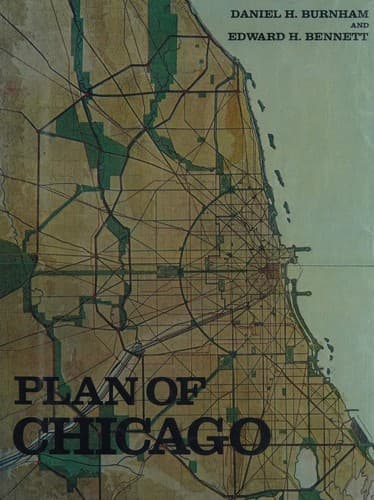
City planning -- Illinois -- Chicago -- History -- 20th century
After the great fire of September, 1666, London had the opportunity, so
frequently offered in America, of rectifying those unfortunate results
which occur in all cities that have grown up; and the sin of omission
in the case of the British metropolis was the more unpardonable,
inasmuch as plans for improvement were prepared by one of the great
architects of the world, Sir Christopher Wren, only to be set aside by
the perverse self-interest of the then citizens of London. Wren’s plans
contemplated a city with streets radiating from central points, and the
locations for public buildings were arranged so as to give pleasing
objects of sight at the end of long vistas,—principles of civic
arrangement which the English architect fixed on paper years before the
French city-builders adopted the same principles for the development
of Paris.[9] The failure of Wren’s scheme of 1666 has cost London
millions upon millions of money to repair in part the errors which
might have been avoided so easily, besides years of inconvenience and
loss due to congestion of traffic. From 1855 to 1900 one project after
another for bettering the conditions in London has been carried out,
at a cost equal to nearly one hundred million dollars; and now the new
Traffic Commission has reported a tentative plan for diminishing the
congestion in street traffic by cutting two great thoroughfares: one
traversing the town from north to south, the other linking Bayswater
with Whitechapel, the estimated cost of the combined work being in the
neighborhood of $125,000,000 for land damages alone.[10]
Recently England has taken up in comprehensive manner the whole subject
of housing the working classes and of town planning. In 1890 a limited
act was passed for the housing of the working classes; and in 1907 this
act was supplemented by “the small holdings and allottments act.” It
is now proposed to extend the provisions of these acts to every urban
and rural district. The powers conferred center in the Local Government
Board, to which local authorities apply for approval of the plans
proposed; and in case these local authorities fail to make application,
the Board may order schemes to be prepared and carried out. There is
also a Public Works Loan Commission which authorizes loans for the
purpose of carrying out the approved plans.[11]
[Illustration: XXIII. ORIGINAL PLAN OF WASHINGTON DESIGNED BY PETER
CHARLES L’ENFANT, 1791.]
Public-domain text, read in full here on John Shaqi.
Reviews
Reviews
No reviews yet
Be the first to share your thoughts on this work.
Join the Discussion
Join the discussion
Sign in to leave a comment or review.
Sign InorCreate an account