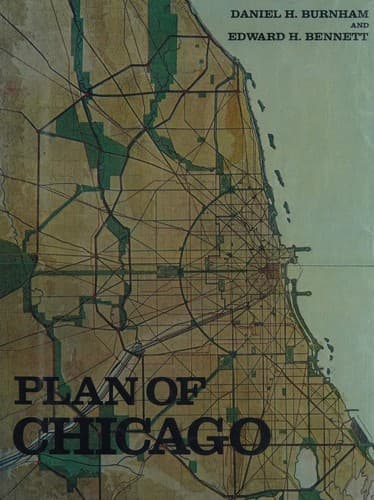
City planning -- Illinois -- Chicago -- History -- 20th century
The question of creating pleasing conditions in a suburb is not
primarily a matter of money, but of thoughtful co-operation. Even the
real estate agent is beginning to discover that by cutting off somewhat
from the depth of his lots he can get park space that will make his
land more available; and by a combination treatment he can secure for
a group of houses an enjoyable area of green grass, to take the place
of the narrow and ill-kept back yards which are at once unsightly
and unsanitary. In every town a public improvement commission should
be formed to bring about the most orderly conditions within the town
itself, and especially to act in co-operation with similar bodies in
neighboring towns so as to secure harmonious, connected, and continuous
improvement.
If we take arbitrarily a radius of sixty miles from the heart of
Chicago and count all the territory in the semi-circumference as
having definite relations with the city, the distance from center to
circumference is no greater than the present suburban electric lines
extend, or the automobilist may cover in a drive of two hours. The
traffic over the ways leading to and from the city is already large and
steady; and the near-by towns and villages along these thoroughfares
may confidently look forward to the day when the tide of Chicago’s
growth will envelop them, and ultimately incorporate them in the city.
Hence two considerations become all-important: first, the improvement
of the thoroughfares, not only those leading to the great city, but
also those which now form the connections between towns and which
ultimately will appear as convenient diagonals within the city itself;
and secondly, the arrangement of the streets of the town, together
with provision for space for the public and semi-public buildings,
and sufficient park and playground area, obtained while land is
comparatively inexpensive.
The suburban movement of population will necessarily increase as the
ground and buildings within the business area of the city become
so valuable for commercial purposes as to preclude their use for
dwellings. In the city of London a thousand policemen are detailed to
guard the five thousand and more buildings left entirely empty each
night. More than one-fifth of all the buildings in the “city” are thus
left vacant at night and on Sunday. Moreover, London, in order to carry
out improvements made to prevent congestion, finds it necessary to
remove and rehouse the working people who are displaced by tearing down
buildings in the over-crowded quarters. On the site of the old Millbank
prison four thousand persons removed at the time of the Holborn to
Strand improvement were rehoused in convenient new dwellings built
by the municipality; and more than fifty thousand people have been
displaced and reinstated by reason of the various improvements. Thus
the city, while drawing from the farms and small towns, also sends out
swarms to be housed under more wholesome conditions.
Public-domain text, read in full here on John Shaqi.
Reviews
Reviews
No reviews yet
Be the first to share your thoughts on this work.
Join the Discussion
Join the discussion
Sign in to leave a comment or review.
Sign InorCreate an account