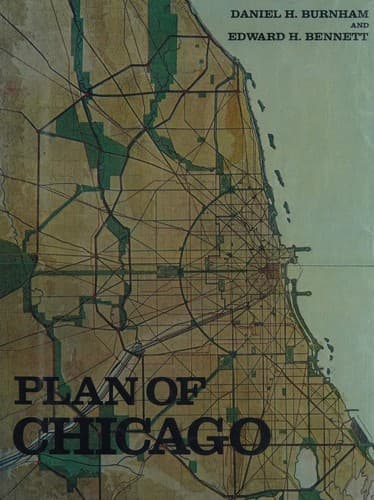
City planning -- Illinois -- Chicago -- History -- 20th century
[19] No roads constructed with smooth surfaces have stood up under
heavy automobile travel, except those made of asphaltum and those made
like the Sheridan Road in Buena Park. The last-mentioned road has gone
through two seasons of very hard usage, and although little repairing
has been done, it seems unchanged as to its surface. In one section
of England considerable stretches of the same sort of construction
have been in service for some time, and with the same result as at
Buena Park. In France two years ago, the main road from Versailles to
Chartres was in first-class condition; going over the same road in
June, 1907, it was found to be almost impassible, the wear upon it
having come from automobiles; and yet this highway was constructed with
care, on the best old-fashioned macadam formula. Asphaltum roads can be
made that will not chip up or pockmark, but the surfacing must be done
so that it will incorporate with the mass beneath, and not rolled on as
an outer layer. A very moderate speed limit for automobiles will keep
roads in good repair, for it is the high speed of the machines that is
so destructive to roadbeds.
[Illustration: XLIII. CHICAGO. WINTER VIEW OF GRANT PARK AND THE
PROPOSED HARBOR, LOOKING EAST.
From the original sketch by E. H. Bennett.
COPYRIGHT, 1909, BY COMMERCIAL CLUB OF CHICAGO ]
CHAPTER IV
THE CHICAGO PARK SYSTEM: THE MOVEMENT FOR PARK EXTENSION:
PLAYGROUNDS: OUTLYING PARK SYSTEMS IN LONDON, PARIS, BERLIN, VIENNA,
AND BOSTON: PROPOSED TREATMENT OF THE LAKE MICHIGAN SHORE: AN OUTER
PARK BELT
Chicago, on becoming a city, chose for its motto _Urbs in horto_—a city
set in a garden. Such indeed it then was, with the opalescent waters
of the Lake at its front, and on its three sides the boundless prairie
carpeted with waving grass bedecked with brilliant wild flowers.
The quick advance of commerce and manufactures, the rapid building
of railroads and factories, and the hastily constructed homes of
operatives crowded out nature’s parterres of flowers. Still the motto
lingered in the minds of men, and in 1839 the struggle began to secure
for the fast-growing population park spaces which should at least
recall the gardens that of necessity had been sacrificed.
In the year mentioned, a half-square on Michigan Avenue, where the
Public Library now stands, comprised the entire park system of the
city of Chicago. Three years later Washington Square was added; then
followed at intervals Jefferson, Union, Ellis, and Vernon parks, each
representing the public spirit of individuals rather than the foresight
of the city. In 1864 the Common Council, having been awakened to the
necessity of providing recreation places for the growing multitudes of
citizens, secured a portion of the lands which later came to be named
Lincoln Park, and the sum of ten thousand dollars was appropriated for
park improvement.
Public-domain text, read in full here on John Shaqi.
Reviews
Reviews
No reviews yet
Be the first to share your thoughts on this work.
Join the Discussion
Join the discussion
Sign in to leave a comment or review.
Sign InorCreate an account