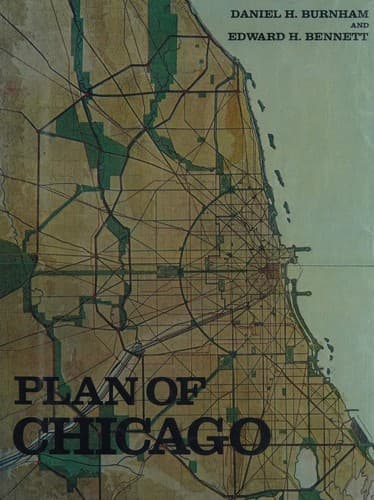
City planning -- Illinois -- Chicago -- History -- 20th century
The conclusion is inevitable. Either nearly every one of the great
railroads must increase and improve both its main line and such of its
freight houses and yards as are now located in the heart of the city,
or they must cease to bring all freight into the congested business
center. Separate roads operating separate and independent rights-of-way
to the separate and independent freight houses cannot do the work.
Year by year the railroads have gone on straightening their lines,
reducing grades, and building additional tracks; and the result has
been large savings in operating expenses. The time has now come to
devise some plan whereby the enormous terminal costs will be lessened
materially; and that city will benefit most wherein this problem shall
be worked out first and best.
This report does not attempt to dictate; or to discuss the practical
questions of railroading. Its aim in respect to transportation is the
same as in regard to all other matters of Chicago’s welfare, namely, to
incorporate such generalizations as are obviously true, logical, and
helpful; because it is recognized fully that unless the railroads have
power to improve their terminals, this city will be hopelessly left
behind in the struggle for commercial advancement. The same spirit that
is evoked to bring about other improvements is necessary also in the
case of the railroads.
[Illustration: DIAGRAM A.]
[Illustration: DIAGRAM B.
LXX. CHICAGO. ASSEMBLING-INTERCHANGE; DIAGRAMS ACCOMPANYING THE REPORT
OF THE COMMITTEE. C. W. HOTCHKISS, CONSULTING ENGINEER.
(A) Present method of handling interchange of freight on railroads in
center of city. (B) Proposed method of handling interchange of freight
on railroads by means of a belt line and clearing yards, disengaging
the center of the city from existing freight congestion.]
In order to obtain for the community as a whole the greatest economy
per ton handled, no goods should be carried into and out of the
congested business center except those needed for construction, for
retailing, or for consumption in that territory. Goods that are now
brought into Chicago as a center, and from thence sold and distributed
to the country outside of Chicago, should be stored at some point
most convenient for the purpose,—most convenient for deposit and for
reloading and carrying away to other points. It is obvious that the
spot chosen be one most convenient for the shipping public as a whole;
and therefore if common ground for such a great general depot can be
found for all the roads, it will best answer the purposes of quick
handling and of lowest cost per ton. A central depot, and common track
facilities which should form a part of it, would bring about time
and money saving both to the railroads themselves and to the trading
public. For the sake, therefore, of the best interests of all the
citizens of Chicago, it is proposed that great machines owned and
operated in common by all the railroads be created to handle freight
business.
Public-domain text, read in full here on John Shaqi.
Reviews
Reviews
No reviews yet
Be the first to share your thoughts on this work.
Elsewhere in the archive
Join the Discussion
Join the discussion
Sign in to leave a comment or review.
Sign InorCreate an account