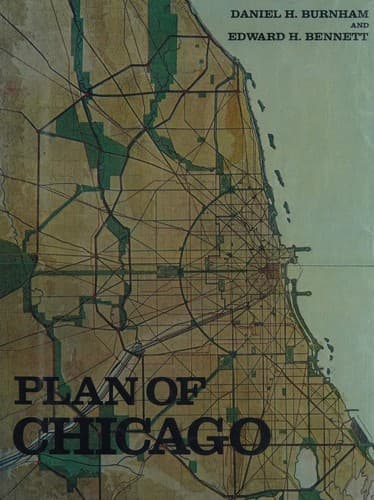
City planning -- Illinois -- Chicago -- History -- 20th century
Not that any one road of the entire twenty-two should be expected to
make what will ultimately prove a sacrifice, but that no road should
hold back from doing its full part to bring about the conditions
essential to the continued prosperity of the city by the development
in Chicago of a unified system of traffic handling that shall place
this city ahead of any other in so far as efficiency and cheapness are
concerned. The fine arts of traffic management should be studied no
less than the fine arts of parks and boulevards; for unless Chicago
keeps ahead of her rivals in commercial matters, the parks will become
pastures, and the boulevards will be deserted.
In an address made in Chicago during the winter of 1906-7 Mr. James
J. Hill laid the utmost stress on the necessity for improved railway
terminals. At that time a cry was going up for more cars. Traffic was
delayed, the railways being entirely unable to handle promptly the
freight offered them. Mr. Hill pointed out that the main difficulty
was not lack of cars, but lack of proper terminal facilities. It was a
fact that hundreds and even thousands of loaded cars were at that very
moment standing on the tracks in the yards of every one of the great
trunk lines, which with their utmost efforts could not place these cars
at the sides of the receiving platforms in the various cities. It is
not an extreme statement to say that business was almost paralyzed on
account of the inability of the roads to handle at the terminals the
freight traffic of the country. On all the two-track lines continuous
trains could have been handled from one terminus to another, if the
cars could have been rescued from the disordering conditions in which
they were involved and lost to use. The railroad companies were unable
to make proper use of their own rolling stock and main lines, all
because of the congested condition of their terminals, in which there
were tracks enough, but tracks so badly placed and arranged as to
deprive the roads of the full benefit of their aggregate mileage.
The bad arrangement of terminal tracks was not alone responsible for
the congested condition which then prevailed at Chicago, New York,
Pittsburgh, and many other points. In an equal or perhaps greater
degree the habit of hauling all the freight into the heart of a city
and then hauling most of it out again was the cause of the trouble. If
freight stations and yards located close to the center of the business
district of a city were inadequate under the conditions that obtained
in the winter of 1906-7, what will be the result at the next test,
which will surely be a more severe one?
Public-domain text, read in full here on John Shaqi.
Reviews
Reviews
No reviews yet
Be the first to share your thoughts on this work.
Elsewhere in the archive
Join the Discussion
Join the discussion
Sign in to leave a comment or review.
Sign InorCreate an account