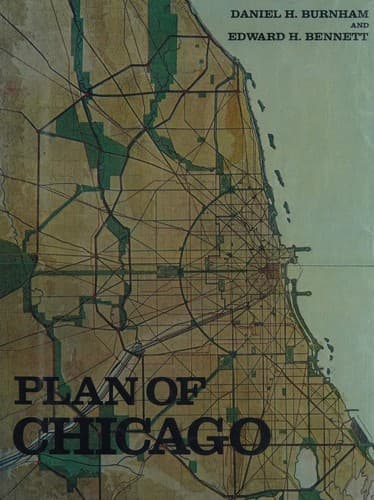
City planning -- Illinois -- Chicago -- History -- 20th century
One of the large retail merchants of Chicago, when in need of a fresh
case of goods, now telephones to his own storehouse situated far from
his shop, and through the underground tunnel quickly receives goods in
a sealed car. This method of supplying the merchant’s needs illustrates
what will happen to all merchants when the central freight depot shall
come fully into existence. A method that will work with precision,
quickness, and close economy will relieve the down-town streets of
freight traffic now hauled over them, and therefore make the streets
cleaner and more lasting. Will not these great general facilities
profoundly affect for the better the material prosperity of Chicago
as a whole? When this system shall be put in operation, the better
street plan, and the enlargement and improvements suggested for parks,
parkways, and the Lake front, will cause the city to become permanently
and highly prosperous.
In connection with the freight diagrams, the one numbered LXXIII
should be considered. It shows a radical change in warehousing, and
perhaps manufacturing, which will take time and cannot be put into
effect abruptly, but is undoubtedly the logical outcome and ultimately
must prevail. It also shows the present tendency of growth of both
manufacturing and warehousing which seems to follow and cling to belt
lines of railroad, especially when such lines run beside the River or
Canal, where every sort of freighting economy now in vogue can be made
use of. It is evident that while present methods continue in use, and
until the great freight scheme can be put into operation, some common
facility railroad highways must be introduced in order to improve the
handling of freight in the direction of quickness and cost. The diagram
(No. LXXIII) shows what these freight common facilities should be,
namely:
1. An inner loop (A),
2. Loop (B), connected as shown with the inner loop,
3. Loop (C), also connected with the inner loop, and finally, loop (D).
If these three loops be wide, many-tracked, and operated for the
benefit of all railroads, then the movement of freight can be increased
in efficiency; and such manufacturers and warehousemen as build against
the loops can be accommodated with everything needed to carry on their
individual activities. Freight stations can be located on these loops
wherever required, and each can be certain of quick and cheap service,
the common facilities being operated by the railroads. A detail diagram
for freight in the center of the city is shown in No. LXXIV.
[Illustration: LXXIII. CHICAGO. DIAGRAM OF THE CITY AND SURROUNDING
COUNTRY, SHOWING RAILROAD CIRCUITS, B, C, D, AND E, WHICH ARE, OR MAY
BECOME, TANGENT TO THE INNER CIRCUIT (A).
The diagram also shows the existing industries, and the probable trend
of growth away from the center of the city.
COPYRIGHT, 1909, BY COMMERCIAL CLUB OF CHICAGO ]
Public-domain text, read in full here on John Shaqi.
Reviews
Reviews
No reviews yet
Be the first to share your thoughts on this work.
Elsewhere in the archive
Join the Discussion
Join the discussion
Sign in to leave a comment or review.
Sign InorCreate an account