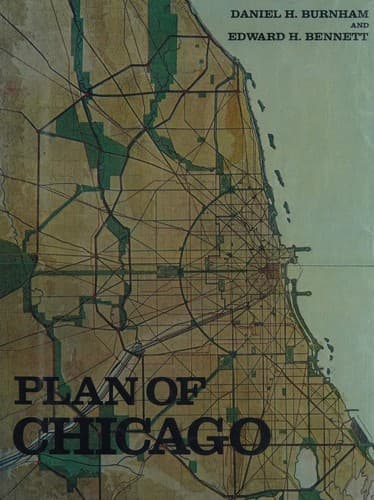
City planning -- Illinois -- Chicago -- History -- 20th century
It is proposed to extend the freight lines to the Lake front piers and
harbors. The excursion-boat piers, as well as the recreation piers and
those at the harbors, are to be thus connected. It is probable that
many of the present freight houses of the railroads will remain and
carry on their functions as at present, except as to goods now hauled
into and out of Chicago, although intended solely for outside trade. As
they are already connected by tunnel, they can be and will be used for
the city-consumption trade, and to supply the great number of smaller
retailers and others who cannot afford to operate separate individual
freight elevators from their shops to the tunnel railroad.
At the present time much of the near-by farm stuff for housekeepers,
hotels, and restaurants is brought into the city on wagons which
load late in the afternoon and travel at night, reaching the general
market at South Water Street or West Market at dawn. Much if not all
of this freightage can be done cheaper to the truck farmers, and more
satisfactorily to the consumer, by cars run at night on the trolley
and elevated lines. Between one and seven o’clock in the morning these
roads should render this important service. The saving of wear and tear
on roadbeds due to the elimination of heavy teaming is, all by itself,
enough to recommend the adoption of the above suggestion. Besides, the
convenience of both producer and consumer is to be considered, and also
the saving of time and the cheapening of provisions.
The proposed street plan of Chicago is based on a system of circuits
and radials. This is also true of the railroad and traction systems. As
shown on the accompanying diagrams, the heart of Chicago is surrounded
by a circuit of railways, which may be said to follow Michigan Avenue,
Canal Street, Sixteenth Street, and Kinzie Street. Following the same
lines, a subway circuit may be constructed for handling freight, and
another for passengers, the latter running, however, on Twelfth and
Washington. To this circuit would be tangent three others enclosing
areas increasing in size around the center of the city as above
described. By means of these circuits a complete system of distribution
of passengers and freight may be secured. To the inner circuit will
relate the various services of distribution of the elements of life,
produce, and commodities for manufacture; and on it should be placed
the freight substations, the markets for general produce, the main
post-office, and postal substations. The various services for water,
sewers, power, telephone, and telegraph, also may be schemed on the
inner circuit as a basis. To it will also correspond the inner circuit
of boulevard circulation.
Public-domain text, read in full here on John Shaqi.
Reviews
Reviews
No reviews yet
Be the first to share your thoughts on this work.
Elsewhere in the archive
Join the Discussion
Join the discussion
Sign in to leave a comment or review.
Sign InorCreate an account