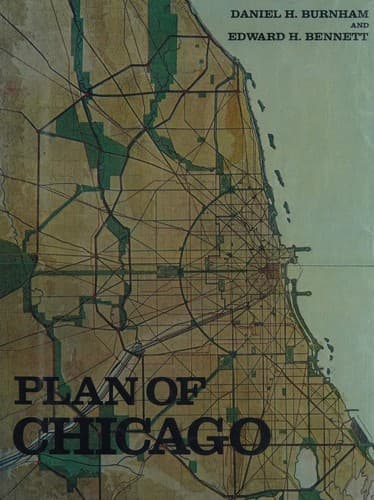
City planning -- Illinois -- Chicago -- History -- 20th century
Although these various circuits do not correspond in exact detail
to one another, they may be said to be virtually superposed, and to
serve not only the intensely active center of the city, but also the
enclosing zone as far as the second boulevard circuit—Michigan Avenue,
Twenty-second Street, Ashland Avenue, and Chicago Avenue—an ideal
condition if the main circulation of the streets be left free and
uninterrupted in its working.
The center line on which balance the circuit A, and all the others to a
greater or less degree, is the axial line of Congress Street. The two
great arteries, Halsted and Congress streets, may be said to form the
grand crossing, at the intersection of which it is proposed to place
the civic center. The base of this civic center touches the west side
of the inner circuit, tangent to which are all the other circuits. The
importance of this inner circuit will thus be seen. The tangent or line
of coincidence extends from Lake Street to Sixteenth Street. It may
be used as the clearing-house for all the interests above described,
coming to and going from the heart of the city.
[Illustration: LXXIV. CHICAGO. DIAGRAM OF THE CITY CENTER, SHOWING THE
GENERAL LOCATION OF EXISTING FREIGHT YARDS AND RAILROAD LINES, THE
PRESENT TUNNEL SYSTEM AND PROPOSED CIRCUIT, AND CONNECTIONS FOR ALL
THESE SERVICES, RUNNING TO THE CENTRAL CLEARING YARDS.
COPYRIGHT, 1909, BY COMMERCIAL CLUB OF CHICAGO ]
The passenger lines entering the densely inhabited parts of the city
should not cross each other or carriage roads at grade. Much has been
done already, and much more is proposed to eliminate grade crossings.
In European cities, and in some American cities as well, the railroads
have taken great pains to beautify their rights-of-way, a step very
important to the roads themselves, to individual passengers, and to the
community at large. Cleanliness and pleasing treatment of the roadways,
the embankments, the drainage channels, the fences, the yards, and
the stations, large and small, insure better service on the part of
the railroad employees, while the appearance of the city is immensely
improved thereby.
[Illustration: LXXV. CHICAGO. DIAGRAM OF THE CITY, SHOWING COMPLETE
SYSTEM OF INNER CIRCUITS.
(1) General traction subway circuit. (2) General railroad freight
circuit.
COPYRIGHT, 1909, BY COMMERCIAL CLUB OF CHICAGO ]
Public-domain text, read in full here on John Shaqi.
Reviews
Reviews
No reviews yet
Be the first to share your thoughts on this work.
Elsewhere in the archive
Join the Discussion
Join the discussion
Sign in to leave a comment or review.
Sign InorCreate an account