City planning -- Illinois -- Chicago -- History -- 20th century
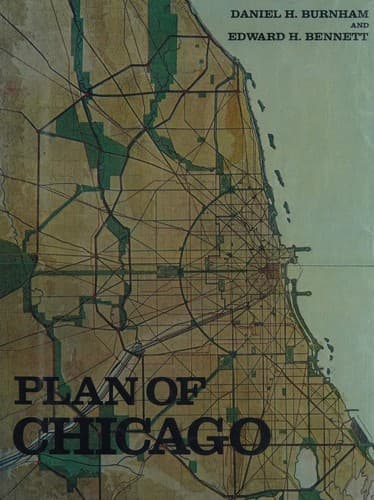
Proposed additional arteries and street widenings (orange); the
present park system (green); the proposed new parks and playgrounds
(hatched green). The proposed diagonal arteries are in every instance
extensions of those already existing, and around the center of the
city they serve to create, in conjunction with rectangular streets,
the proposed circuit boulevards.
COPYRIGHT, 1909, BY COMMERCIAL CLUB OF CHICAGO ]
[Illustration: LXXXVII. CHICAGO. VIEW LOOKING WEST OVER THE CITY,
SHOWING THE PROPOSED CIVIC CENTER, THE GRAND AXIS, GRANT PARK, AND
THE HARBOR.
Painted for the Commercial Club by Jules Guerin.
COPYRIGHT, 1909, BY COMMERCIAL CLUB OF CHICAGO ]
[Illustration: LXXXVIII. CHICAGO. MAP SHOWING THE SUCCESSIVE CITY
LIMITS, AND A LINE TRACED FROM THE SITE OF FORT DEARBORN THROUGH THE
PRESENT CENTER OF POPULATION, REPRESENTING THE GENERAL TENDENCY OF
GROWTH.
COPYRIGHT, 1909, BY COMMERCIAL CLUB OF CHICAGO ]
In all growing cities it has been necessary, as it is now necessary
in Chicago, to break through the conditions imposed by the lack of
an adequate and comprehensive plan at the beginning, and to create,
at large expense, those thoroughfares and boulevards and public
squares which the increasing demands of population and the larger
requirements of civic life require. The longer the beginning has been
postponed the harder has been the task and the greater the expense;
but whatever the labor and however large the cost, the result has
always been found more than compensation for the outlay. And so it
will be with Chicago. Every year of postponement will deprive its
citizens of advantages they might have enjoyed had they carried
out improvements the necessities of which have been universally
acknowledged.
People flock to those cities where conditions of work are good, where
means of recreation abound, and where there are attractions for the
senses and the intellect. Persons of wealth and refinement seek
such cities as their abiding-places; and those who have accumulated
wealth in a city bent on improvement remain there. Moreover, there
is no stronger appeal made to the American citizen of to-day than
comes from the call of one’s native or adopted city to enter upon the
service of creating better surroundings not only for one’s self, but
for all those who must of necessity earn their bread in the sweat
of their brows. Nor is the call of posterity to be denied. To love
and render service to one’s city, to have a part in its advancement,
to seek to better its conditions and to promote its highest
interests,—these are both the duty and the privilege of the patriot
of peace.
[Illustration: LXXXIX. CHICAGO. DIAGRAM OF GENERAL SCHEME OF STREET
CIRCULATION AND PARKS IN RELATION TO THE POPULATION.
The various densities of population, ranging from 0 to 25 persons per
acre to 250 to 300 per acre are indicated by different densities of
red color. The center of population is indicated by a star. Railroads
are shown in blue.
Public-domain text, read in full here on John Shaqi.
Reviews
Reviews
No reviews yet
Be the first to share your thoughts on this work.
Elsewhere in the archive
Join the Discussion
Join the discussion
Sign in to leave a comment or review.
Sign InorCreate an account