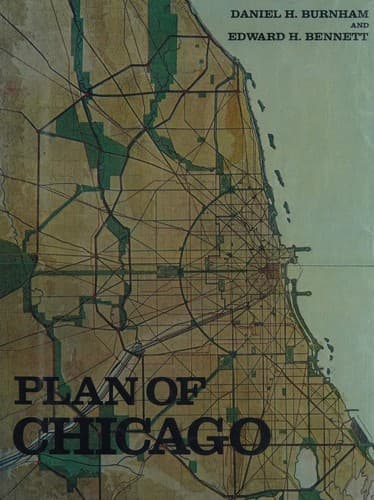
City planning -- Illinois -- Chicago -- History -- 20th century
In laying out new thoroughfares or treating old ones it must be
remembered that with respect to traffic streets the increase in
population is constantly making larger demands for width, and that
on residence streets the city should not be burdened unnecessarily
with the cost of street construction and maintenance. Moreover,
there is great economy in the distinct separation of residence
streets from traffic streets. Whenever a street railway seizes upon
a residence street of ordinary size, that street immediately begins
to undergo transformation into a business street; and this change
while working its slow way causes depreciation in land values which,
save on favorably located corners, amounts to virtual confiscation.
With good planning these ruinous transformations become unnecessary,
and the purchase of a home then becomes a stable investment and not
a gambling hazard. Again, in every country experience has proved
that the clear and even remorseless cutting of main lines through
the district to be developed, and the division of great blocks into
traffic arteries and service streets is the soundest economy, as well
as the most effective means of reaching the sought-for end.
The second form of traffic interruption, arising from the
intersection of lines of movement, is complicated by reason of the
fact that here the pedestrian movement, as well as the vehicular
movement, must be taken into consideration. There are times when men
gather in the streets for patriotic purposes, as on the Fourth of
July and Decoration Day; or because of an eager desire to learn the
news of great events, like election results. The right of the people
to assemble for discussion is fundamental. All these requirements
must be met by the creation of open spaces, which appropriately may
be adorned by the statues of men of achievement, or may be ornamented
with fountains and memorials of various kinds. These spaces for
assembly and for embellishment should be arranged so as to allow
traffic to flow unvexing and unvexed. Nothing could be more of a
makeshift than the arbitrary regulations of the police in many of our
cities, where long detours are imposed on the wayfarer and vehicle
alike, in order to diminish that congestion which it is the task of
the city planner to prevent. Yet in no city in the world has this
intricate and perplexing problem been completely solved.
Public-domain text, read in full here on John Shaqi.
Reviews
Reviews
No reviews yet
Be the first to share your thoughts on this work.
Elsewhere in the archive
Join the Discussion
Join the discussion
Sign in to leave a comment or review.
Sign InorCreate an account