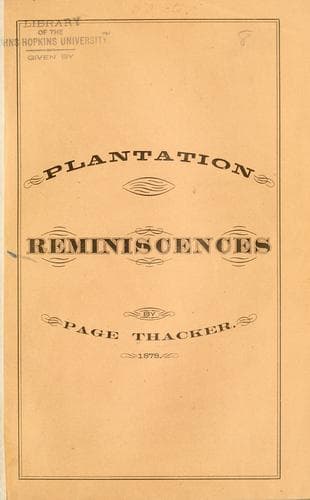
Plantation life; Virginia -- Social life and customs
Among the negroes--one hundred--on our plantation, many had been taught
different trades; and there were blacksmiths, carpenters, brick masons,
millers, shoemakers, weavers, spinners, all working for themselves.
No article of their handicraft ever being sold from the place, their
industry resulted in nothing beyond feeding and clothing themselves.
My sister and myself, when very small children, were often carried to
visit these cabins, on which occasions no young princesses could have
received from admiring subjects more adulation. Presents were laid at
our feet--not glittering gems--but eggs, chesnuts, popcorn, walnuts,
melons, apples, sweet potatoes, all their "cupboards" afforded, with a
generosity unbounded. This made us as happy as queens; and filled our
hearts with kindness and gratitude to our dusky admirers.
Around the cabin doors the young negroes would quarrel as to who should
be his or her mistress; some claiming me, and others my sister.
All were merry-hearted, and among them I never saw a discontented face.
Their amusements were dancing to the music of the banjo, quilting
parties, opossum hunting, and, sometimes, weddings and parties.
Many could read, and in almost every cabin was a Bible. In one was
a Prayer-book, kept by one of the men--a preacher--from which he
read the marriage ceremony at the weddings. This man opened a night
school--charging twenty-five cents a week--hoping to inspire some
literary thirst among the rising generation, who, however, preferred
their nightly frolics to the school, so it had few patrons.
Our house servants were numerous, polite and well trained. My mother
selected those most obliging in disposition and quick at learning, who
were brought to the house at ten or twelve years of age, and instructed
in the branches of household employment.
These small servants were always dressed in the cleanest, whitest
long-sleeved aprons, with white or red turbans on their heads. No
establishment being considered complete without a multiplicity of
these; they might be seen constantly darting about on errands from the
house to the kitchen and the cabins; up stairs and down stairs, being
indeed omnipresent and indispensable.
It was the custom for a lady visitor to be accompanied to her room at
night by one of these black, smiling "indispensables," who insisted so
good naturedly on performing all offices, combing her hair, pulling off
her slippers, &c., that one had not the heart to refuse, although it
would have been sometimes more agreeable to have been left alone.
The negroes were generally pleased at the appearance of visitors,
from whom they were accustomed to receive some present on arriving or
departing, the neglect of which was considered a breach of politeness.
Public-domain text, read in full here on John Shaqi.
Reviews
Reviews
No reviews yet
Be the first to share your thoughts on this work.
Join the Discussion
Join the discussion
Sign in to leave a comment or review.
Sign InorCreate an account