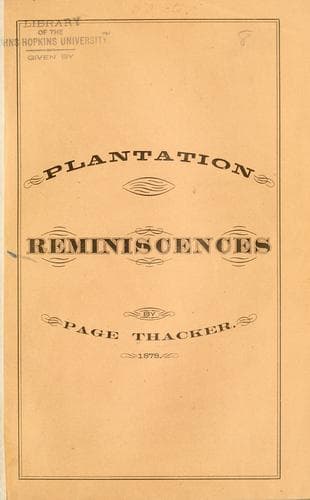
Plantation life; Virginia -- Social life and customs
While we were purchasing some trifles to bring home to some of our
servants, a lady, who had entertained us most kindly at her house on
Fifth Avenue, expressing surprise, said: "_We_ never think of bringing
home presents to our 'helps.'"
This was the first time we had ever heard, instead of "servant," the
word "help," which seemed then--and still seems--misapplied. The
dictionaries define "help" to mean aid; assistance; remedy, while
"servant" means one who attends another, and acts at his command. When
a man pays another to "help" him, it implies he is to do part of the
work himself, and is dishonest if he leaves the whole to be performed
by his "help."
The word servant is an honest Bible word, and distinctly defines a
position. Noah did not say: "Cursed be Cain, a 'help' of 'helps' shall
he be to his brethren." Nor did Abraham call his eldest "servant,"
although ruling over all he had, his "help." Neither does the
Commandment say thy "man-help" or thy "maid-help."
The word "servant" seems, after the lapse of centuries, still applied
with the same meaning by St. Paul, who does not say, "Master, give
unto your 'helps' that which is equal;" or, "Let as many 'helps' as are
under the yoke count their own masters worthy of all honor."
The words "master and servant" thus lose their true significance.
Among other discoveries during this visit we found how much more talent
it requires to entertain company in the country than the city. In the
latter the guests and family form no "social circle round the blazing
hearth" at night, but disperse far and wide, to be entertained at the
concert, the opera, the theater or club; while in the country one
depends entirely upon native intellect and conversational talent.
And oh! the memory of our own fireside circles! The exquisite women;
the men of giant intellect, eloquence and wit at sundry times assembled
there! Could our andirons but utter speech what could they not tell
of mirth and song, eloquence and wit, whose flow made many an evening
bright.
Well, as all delights must have an end, the time came for us to leave
these "scenes enchanting." Bidding adieu forever to the land of "modern
appliances" and stale bread, we returned to the land flowing with "old
ham and corn cakes," and were soon surrounded by friends who came to
hear the marvels we had to relate.
How monotonous, how dull, prosy, inconvenient everything seemed after
our plunge into modern life!
We told old Virginia about all the enterprise we had seen; and how she
was left far behind everybody and everything, urging her to join at
once the "march of material progress."
But the mother of States persisted in sitting contentedly over her old
fashioned wood fire with brass andirons, and while thus musing these
words fell slowly and distinctly from her lips:
Public-domain text, read in full here on John Shaqi.
Reviews
Reviews
No reviews yet
Be the first to share your thoughts on this work.
Join the Discussion
Join the discussion
Sign in to leave a comment or review.
Sign InorCreate an account