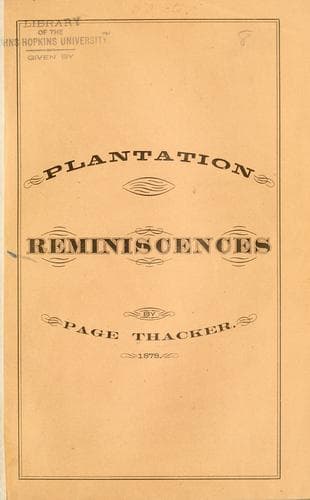
Plantation life; Virginia -- Social life and customs
"How do you know?" I asked, supposing he would say: "By their plain
style of dress and antiquated breastpins."
Said he: "I've been running a boat from Cincinnati to New Orleans for
twenty-five years, and often have three hundred passengers from various
parts of the world. But if there is a Virginia lady among them, I find
it out in half an hour. They take things quietly, and don't complain.
Do you see that English lady over there? Well, she has been complaining
all the way up the Mississippi river. Nobody can please her. The
cabin-maid and steward are worn out with trying to please her. She says
it is because the mosquitoes bit her so badly coming through Louisiana.
But we are almost at Cincinnati now; haven't seen a mosquito for a
week, and she is still complaining!"
"Then," he continued, "the Virginia ladies look as if they could not
push about for themselves, and for this reason I always feel like
giving them more attention than the other passengers."
"We are inexperienced travelers," I replied.
And these remarks of the Captain convinced me--I had thought it
before--that Virginia women should never undertake to travel, but
content themselves with staying at home. However, such restriction
would have been unfair, unless they had felt like the Parisian who,
when asked why the Parisians never traveled, replied: "Because all the
world comes to Paris!"
Indeed, a Virginian had an opportunity of seeing much choice society
at home; for our watering places attracted the best people from other
States, who often visited us at our houses.
On the Mississippi boat to which I have alluded, it was remarked
that the negro servants paid the Southerners more constant and
deferential attention than the passengers from the non-slaveholding
States--although some of the latter were very agreeable and intelligent,
and conversed with the negroes on terms of easy familiarity--showing,
what I had often observed, that the negro respects and admires those
who make a "social distinction" more than those who make none.
CHAPTER X.
We were surprised to find in an "Ode to the South," by Mr. M. F.
Tupper, published recently, the following stanza:
"Yes it is slander to say you oppress'd them
Does a man squander the prize of his pelf.
Was it not often that he who possessed them
Rather was owned by his servants himself?"
This was true, but that it was known in the outside world we thought
impossible, when all the newspaper and book accounts represented us
as "miserable sinners" for whom there was no hope here or hereafter,
and called upon all nations, Christian and civilized, to "revile,
persecute and exterminate us." Such representations, however, differed
so widely from the facts around us, that when we heard them they failed
to produce a very serious impression, occasioning often only a smile,
with the exclamation: "How little those people know about us!"
Public-domain text, read in full here on John Shaqi.
Reviews
Reviews
No reviews yet
Be the first to share your thoughts on this work.
Join the Discussion
Join the discussion
Sign in to leave a comment or review.
Sign InorCreate an account