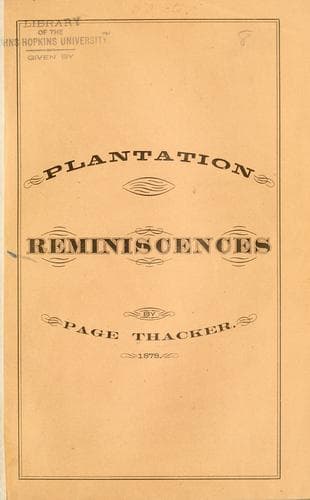
Plantation life; Virginia -- Social life and customs
In this connection, I am reminded of a tradition in the Greenfield
family, which showed the heroism of a Virginia boy:
The first white proprietor of this place, the great grandfather of the
present owners, had also a large estate in Montgomery county, called
Smithfield, where his family lived, and where was a fort for the
protection of the whites, when attacked by the Indians.
Once, while the owner was at his Greenfield place, the Indians
surrounded Smithfield, when the white women and children took refuge in
the fort, and the men prepared for battle. They wanted the proprietor
of Smithfield to help fight and take command, for he was a brave man,
but could not spare a man to carry him the news. So they concluded
to send one of his young sons, a lad thirteen years old, who did not
hesitate but mounting a fleet horse set off after dark and rode all
night through dense forests filled with hostile Indians, reaching
Greenfield, a distance of forty miles next morning. He soon returned
with his father, and the Indians were repulsed. And I always thought
that boy was courageous enough for his name to live in history.[3]
The Indians afterwards told that the whole day before the fight several
of their chiefs had been concealed near the Smithfield house, under a
large hay stack, upon which the white children had been sliding and
playing all day, little suspecting the gleaming tomahawks and savage
men beneath.
From the Greenfield estate in Botetourt and the one adjacent went the
ancestors of the Prestons and Breckinridges, who made these names
distinguished in South Carolina and Kentucky. And on this place are the
graves of the first Breckinridges who emigrated to this country.
All who visited at the homesteads just described retained ever after a
recollection of the superbly cooked meats, bread, &c., seen upon the
tables at both houses--there being at each place five or six negro
cooks, who had been taught by their mistresses the highest style of the
art.
During the summer season several of these cooks were hired at the
different watering places, where they acquired great fame and made for
themselves a considerable sum of money by selling recipes.
A lady of the Greenfield family, who married and went to Georgia, told
me she had often tried to make velvet rolls like those she had been
accustomed to see at her own home, but never succeeded. Her mother and
aunt who had taught these cooks, having died many years before, she had
to apply to the negroes for information on such subjects, and they, she
said, would never show her the right way to make them. Finally, while
visiting at a house in Georgia, this lady was surprised to see the very
velvet rolls, like those at her home.
"Where did you get the recipe?" she soon asked the lady of the house,
who replied, "I bought it from old Aunt Rose, a colored cook, at the
Virginia Springs, and paid her five dollars."
Public-domain text, read in full here on John Shaqi.
Reviews
Reviews
No reviews yet
Be the first to share your thoughts on this work.
Join the Discussion
Join the discussion
Sign in to leave a comment or review.
Sign InorCreate an account