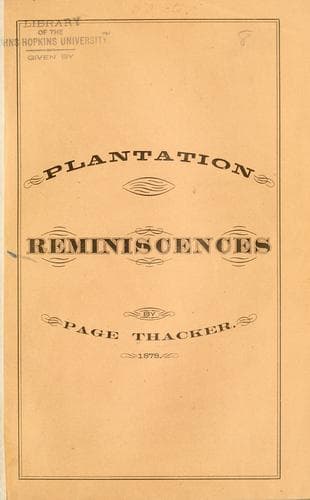
Plantation life; Virginia -- Social life and customs
While the tide water Virginians were already practicing all the arts
and wiles known to the highest English civilization; were sending their
sons to be educated in England; receiving brocaded silks and powdered
wigs from England; and dancing the minuet at the Williamsburg balls
with the families of the noblemen sent over to govern the Colony,
Piedmont, Virginia, was still a dense forest, the abode of Indians and
wild animals.
It was not strange, then, that the Piedmont Virginians never arrived
at the opulent manner of living adopted by those on James and York
rivers, who, tradition tells us, went to such excess in high living, as
to have "hams boiled in champagne," and of whom other traditions have
been handed down amusing and interesting. Although the latter were in
advance of the Piedmont Virginians in wealth and social advantages,
they were not superior to them in honor, virtue, or kindness and
hospitality.
It has been remarked that, "when natural scenery is picturesque there
is in the human character something to correspond; impressions made on
the retina are really made on the soul, and the mind becomes what it
contemplates."
The same author continues: "A man is not only _like_ what he sees,
but he _is_ what he sees. The noble old Highlander has mountains in
his soul, whose towering peaks point heavenward; and lakes in his
bosom, whose glassy surface reflects the skies; and foaming cataracts
in his heart to beautify the mountain side and irrigate the vale; and
evergreen firs and mountain pines that show life and verdure even under
winter skies!"
"On the other hand," he writes, "the wandering nomad has a desert in
his heart; its dead level reflects heat and hate; a sullen, barren
plain--no goodness, no beauty, no dancing wave of joy, no gushing
rivulet of love, no verdant hope. And it is an interesting fact that
those who live in countries where natural scenery inspires the soul,
and where the necessities of life bind to a permanent home, are always
patriotic and high minded; and those who dwell in the desert are always
pusillanimous and groveling!"
If what this author writes be true, and the character of the Piedmont
Virginians accords with the scenery around them, how their hearts must
be filled with gentleness and charity inspired by the landscape which
stretches far and fades in softness against the sky! How must their
minds be filled with noble aspirations suggested by the "everlasting
mountains!" How their souls must be filled with thoughts of heaven,
as they look upon the glorious sunsets bathing the mountains in
"rose-colored light;" with the towering peaks ever pointing heavenward
and seeming to say: "Behold the glory of a world beyond!"[5]
Beneath the shadow of the "Peaks" were many happy homes and true
hearts, and among these memory recalls none more vividly than
"Otterburn" and its inmates.
Public-domain text, read in full here on John Shaqi.
Reviews
Reviews
No reviews yet
Be the first to share your thoughts on this work.
Join the Discussion
Join the discussion
Sign in to leave a comment or review.
Sign InorCreate an account