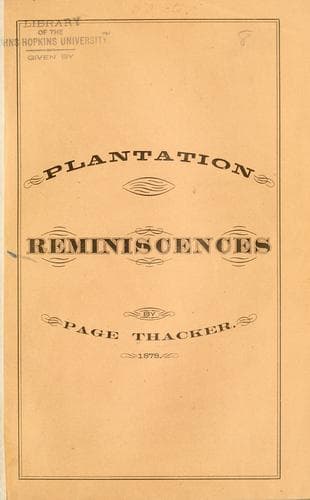
Plantation life; Virginia -- Social life and customs
The negroes on the these estates appeared lively and happy; that is,
if singing and laughing indicates happiness; for they went to their
work in the fields singing, and returned in the evening singing, after
which they often spent the whole night visiting from one plantation to
another, or dancing until day to the music of the banjo or "fiddle."
These dances were wild and boisterous, their evolutions being like
those of the savage dances, described by travelers in Africa. Although
the most perfect timists, their music with its wild, melancholy
cadence, half savage, half civilized, can not be imitated or described.
Many a midnight were we wakened by their wild choruses, sung as they
returned from a frolic or "corn shucking," sounding at first like some
hideous, savage yell, but dying away on the air, echoing a cadence
melancholy and indescribable, with a peculiar pathos, and yet without
melody or sweetness.
"Corn shuckings" were occasions of great hilarity and good eating.
The negroes from various plantations assembled at night around a huge
pile of corn. Selecting one among them, the most original, amusing and
having the loudest voice, they called him "Captain." The "Captain"
seated himself on top of the pile--a large lightwood torch burning in
front of him--and while he shucked improvised words and music to a
wild "recitative," the chorus of which was "caught up" by the army of
"shuckers" around. The glare of the torches on the black faces, with
the wild music and impromptu words, made a scene curious even to us who
were so accustomed to it.
After the corn was shucked they assembled around a table laden with
roast pigs, mutton, beef, hams, cakes, pies, coffee, and other
substantials--many participating in the supper who had not in the work.
The laughing and merriment continued until one or two o'clock in the
morning.
* * * * *
On these James river plantations were entertained often distinguished
foreigners, who visiting Richmond desired to see something of Virginia
country life. Mr. Thackeray was once entertained at one of them. But
Dickens never visited them. Could he have passed a month, at any one
of the homes I have described, he would have written something more
flattering, I am sure, of Americans and American life than is found
in "Martin Chuzzlewit" and "Notes on America." However, with these we
should not quarrel, as some of the sketches--especially the one on
"tobacco chewers," we can recognize.
Public-domain text, read in full here on John Shaqi.
Reviews
Reviews
No reviews yet
Be the first to share your thoughts on this work.
Join the Discussion
Join the discussion
Sign in to leave a comment or review.
Sign InorCreate an account