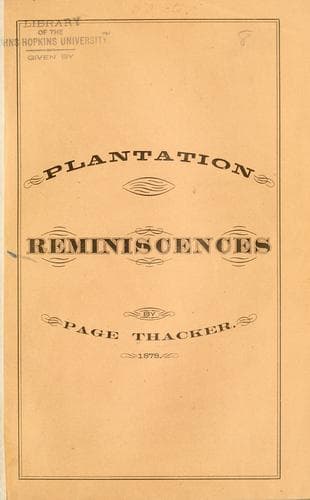
Plantation life; Virginia -- Social life and customs
Madam D'Arblay--whose maiden name was Frances Burney--was the first
female novelist in England, who deserved and received the applause
of her countrymen. The most eminent men of London paid homage to her
genius. Johnson, Burke, Windham, Gibbon, Reynolds, Sheridan, were
her friends and ardent eulogists. In the midst of her literary fame,
surrounded by congenial friends, herself a star in this select and
brilliant coterie, she was offered the place of waiting maid in the
palace. She accepted the position, and bade farewell to all congenial
friends and pursuits. "And now began," says Macaulay, "a slavery of
five years--of five years taken from the best part of her life, and
wasted in menial drudgery. The history of an ordinary day was this:
Miss Burney had to rise and dress herself early, that she might be
ready to answer the royal bell, which rang at half after seven. Till
about eight she attended in the Queen's dressing-room, and had the
honor of lacing her august mistress' stays, and of putting on the
hoop, gown and neckhandkerchief. The morning was chiefly spent in
rummaging drawers and laying fine clothes in their proper places. Then
the Queen was to be powdered and dressed for the day. Twice a week her
Majesty's hair had to be curled and craped; and this operation added a
full hour to the business of the toilet. It was generally three before
Miss Burney was at liberty. At five she had to attend her colleague,
Madame Schwellenberg, a hateful old toadeater, as illiterate as a
chamber-maid, proud, rude, peevish, unable to bear solitude, unable to
conduct herself with common decency in society. With this delightful
associate Frances Burney had to dine and pass the evening. The pair
generally remained together from five to eleven, and often had no other
company the whole time. Between eleven and twelve the bell rang again.
Miss Burney had to pass a half hour undressing the Queen, and was then
at liberty to retire.
"Now and then, indeed, events occurred which disturbed the wretched
monotony of Frances Burney's life. The court moved from Kew to Windsor,
and from Windsor back to Kew.
"A more important occurrence was the King's visit to Oxford. Then Miss
Burney had the honor of entering Oxford in the last of a long string
of carriages, which formed the royal procession, of walking after the
Queen all day through refectories and chapels, and of standing half
dead with fatigue and hunger, while her august mistress was seated at
an excellent cold collation. At Magdalen College, Frances was left for
a moment in a parlor, where she sank down on a chair. A good natured
equerry saw that she was exhausted, and shared with her some apricots
and bread, which he had wisely put in his pockets. At that moment the
door opened, the Queen entered, the wearied attendants sprang up, the
bread and fruit were hastily concealed.
Public-domain text, read in full here on John Shaqi.
Reviews
Reviews
No reviews yet
Be the first to share your thoughts on this work.
Join the Discussion
Join the discussion
Sign in to leave a comment or review.
Sign InorCreate an account