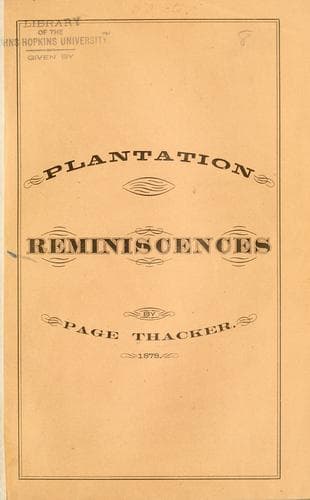
Plantation life; Virginia -- Social life and customs
At last Miss Burney's father was moved to compassion and allowed her
to write a letter of resignation. "Still I could not," writes Miss
Burney in her diary, "summon courage to present my memorial from seeing
the Queen's entire freedom from such an expectation. For though I was
frequently so ill in her presence that I could hardly stand, I saw she
concluded me, while life remained, inevitably hers."
"At last, with a trembling hand, the paper was delivered. Then came the
storm. Madame Schwellenberg raved like a maniac. The resignation was
not accepted. The father's fears were aroused, and he declared, in a
letter meant to be shown to the Queen, that his daughter must retire.
The Schwellenberg raged like a wild cat. A scene almost horrible ensued.
"The Queen then promised that, after the next birthday, Miss Burney
should be set at liberty. But the promise was ill kept; and her Majesty
showed displeasure at being reminded of it."
At length, however, the prison door was opened, and Frances was free
once more. Her health was restored by traveling, and she returned to
London in health and spirits. Macaulay tells us that she went to visit
the palace, "her _old dungeon, and found her successor already far
on the way to the grave, and kept to strict duty, from morning till
midnight, with a sprained ankle and a nervous fever_."
An ignorant and unlettered woman would doubtless not have found this
life in the palace tedious, and our sympathy would not have been
aroused for her; for as long as the earth lasts there must be human
beings fitted for every station, and it is supposed, till the end of
all things, there must be cooks, housemaids and dining-room servants,
which will make it never possible for the whole human family to stand
entirely upon the same platform socially and intellectually. And Miss
Burney's wretchedness, which calls forth our sympathy, was not because
she had to perform the duties of waiting-maid, but because to a gifted
and educated woman these duties were uncongenial; and congeniality
means _happiness_; uncongeniality _unhappiness_.
CHAPTER XIV.
From the sorrows of Miss Burney in the palace--a striking contrast
with the menials described in our own country homes--I will return to
another charming place on James river--Powhatan Seat--a mile below
Richmond, which had descended in the Mayo family two hundred years.
Here, it was said, the Indian chief Powhatan had lived, and here was
shown the veritable stone supposed to have been the one upon which
Captain Smith's head was laid, when the Indian princess Pocahontas
rescued him.
Public-domain text, read in full here on John Shaqi.
Reviews
Reviews
No reviews yet
Be the first to share your thoughts on this work.
Join the Discussion
Join the discussion
Sign in to leave a comment or review.
Sign InorCreate an account