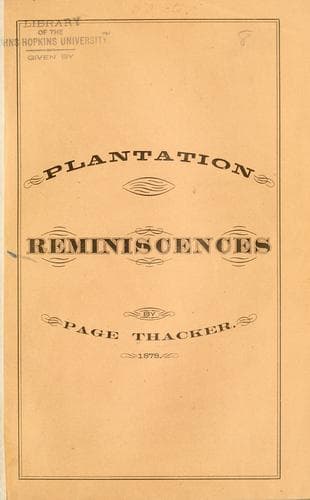
Plantation life; Virginia -- Social life and customs
Elkwood--like many other old homes--was burned by the Northern army in
1862, and not a tree or flower remains to mark the spot, for so many
years the abode of hospitality and good cheer.
In connection with Culpeper it is due here to state that this
county excelled all others in ancient and dilapidated buggies and
carriages--seeming a regular infirmary for all the disabled vehicles
of the Old Dominion. Here their age and infirmities received every
care and consideration, being propped up, tied up and bandaged up in
every conceivable manner; and strangest of all, rarely depositing their
occupants in the road, which was prevented by cautious old gentlemen
riding alongside, who watching out, and discovering the weakest points,
stopped and securely tied up fractured parts with bits of twine, rope
or chain, always carried in buggy or carriage boxes for that purpose.
These surgical operations, although not ornamental, strengthened and
sustained these venerable vehicles, and produced a longevity miraculous.
Many more sketches might be given of pleasant country homes--worthy
a better pen than mine--for Brandon, Westover, Shirley, Carter Hall,
Lauderdale, Vaucluse, and others, linger in the memory of hundreds
who once knew and loved them. Especially Vaucluse, which although
far removed from railroads, stage coaches and public conveyances was
overflowing with company throughout the year. For the Vaucluse girls
were so bright, so fascinating, so bewitchingly pretty, they attracted
a concourse of visitors, and were sure to be belles wherever they went.
And many remember the owner of Vaucluse--that pure hearted Christian
and cultivated gentleman, who, late in life, devoted himself to the
Episcopal ministry, and labored faithfully in the Master's cause
preaching in country churches, "without money, and without price."
Surely his reward is in heaven.
* * * * *
Besides these well ordered establishments, there were some others
owned by inactive men, who smoked their pipes, read their books, left
everything very much to the management of their negroes and seemed
content to let things tumble down around them.
One of these places we used to call "Topsy-Turvy Castle," and another
"Haphazard."
At such places the negro quarters--instead of neat rows of white
cabins in rear of the house, as on other plantations--occupied a
conspicuous place near the front, and consisted of a solid, long, ugly
brick structure, with swarms of negroes around the windows and doors,
appearing to have nothing in the world to do, and never to have done
anything.
Public-domain text, read in full here on John Shaqi.
Reviews
Reviews
No reviews yet
Be the first to share your thoughts on this work.
Join the Discussion
Join the discussion
Sign in to leave a comment or review.
Sign InorCreate an account