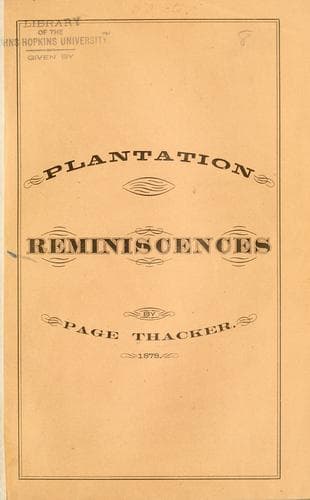
Plantation life; Virginia -- Social life and customs
And so with everything the old lady sent, only keeping for his own
house the articles which could not be possibly used for the College or
chapel--a quaint work-table, an ornamental clock and some old fashioned
preserve dishes--although his own house was then bare enough, and the
old lady had particularly requested that only those articles which they
did not need should go to the College.
The recollection of this visit, although reviving many pleasant hours,
is very sad, for it was the last time I saw the dear, kind face of Mrs.
Lee; of whom the General once said when one of us, alluding to him,
used the word "hero:" "My dear, _Mrs._ Lee is the hero. For although
deprived of the use of her limbs, by suffering, and unable for ten
years to walk I have never heard her murmur or utter one complaint."
And the General spoke truly, Mrs. Lee was a heroine. With gentleness,
kindness and true feminine delicacy, she had strength of mind and
character a man might have envied. Her mind well stored and cultivated
made her interesting in conversation; and a simple cordiality of manner
made her beloved by all who met her.
During this last visit she loved to tell about her early days at
Arlington--her own and her ancestors' plantation home--and in one of
these conversations gave me such a beautiful sketch of her mother--Mrs.
Custis--that I wish her every word could be remembered that I might
write it here.
Mrs. Custis was a woman of saintly piety, her devotion to good works
having long been a theme with all in that part of Virginia. She had
only one child--Mrs. Lee--and possessed a very large fortune. In early
life she felt that God had given her a special mission, which was to
take care of and teach the three hundred negroes she had inherited.
"Believing this," said Mrs. Lee to me, "my mother devoted the best
years of her life to teaching these negroes, for which purpose she had
a school house built in the yard, and gave her life up to this work;
and I think it an evidence of the ingratitude of their race, that
although I have long been afflicted, only one of those negroes has
written to enquire after me, or offered to nurse me."
These last years of Mrs. Lee's life were passed in much suffering,
being unable to move any part of her body except her hands and head.
Yet her time was devoted to working for her church. Her fingers were
always busy with fancy work, painting or drawing--she was quite an
accomplished artist--which were sold for the purpose of repairing and
beautifying the church in sight of her window, and as much an object
of zeal and affection with her, as the chapel was with the General.
Indeed the whole family entered into the General's enthusiasm about
this chapel--just then completed--especially his daughter Agnes, with
whom I often went there, little thinking it was so soon to be her place
of burial.
Public-domain text, read in full here on John Shaqi.
Reviews
Reviews
No reviews yet
Be the first to share your thoughts on this work.
Elsewhere in the archive
Join the Discussion
Join the discussion
Sign in to leave a comment or review.
Sign InorCreate an account