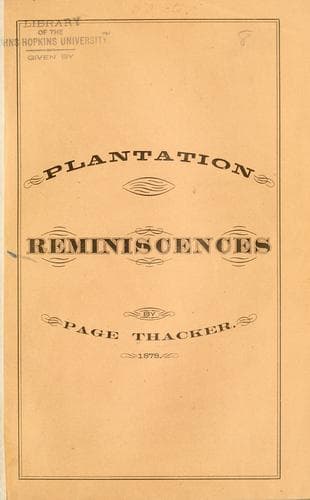
Plantation life; Virginia -- Social life and customs
In a few short years all three--General Lee, his wife and daughter--were
laid here to rest, and this chapel they had loved so well became their
tomb.
CHAPTER XIX.
All plantation reminiscences resemble a certain patch-work, made when
we were children, of bright pieces joined with black squares. The black
squares were not pretty, but if left out, the character of the quilt
was lost. And so with the black faces, if left out of our home pictures
of the past, the character of the picture is destroyed.
What I have written is a simple record of facts in my experience
without an imaginary scene or character; intended for the descendants
of those who owned slaves in the South, and who may in future wish
to know something of the high-toned character and virtues of their
ancestors.
The pictures are strictly true, and should it be thought by any that
the brightest have alone been selected, I can only say, I knew no
others.
It would not be possible for any country to be entirely exempt from
crime and wickedness; and here, too, these existed; for prisons,
penitentiaries and courts of justice were, as elsewhere, important; but
it is a sincere belief that the majority of Southern people were true
and good. And that they have accomplished more than any other nation
towards civilizing and elevating the negro race, may be shown from the
following paragraph in a late magazine:
"From a very early date the French had their establishment on the
Western coast of Africa. In 1364 their ships visited that portion of
the world. But with all this long intercourse with the white man the
natives have profited little. _Five centuries_ have not civilized them,
so as to be able to build up institutions of their own. Yet the French
have always succeeded better than the English with the negro and Indian
element."
Civilization and education are slow; for, says a modern writer:
"After the death of Roman intellectual activity, the seventh and eighth
centuries were justly called dark. If Christianity was to be one of
the factors in producing the present splendid enlightenment, she had
no time to lose, and she lost no time. She was the only power at that
day that could begin the work of enlightenment. And starting at the
very bottom, she wrought for _nine hundred years_ alone. The materials
she had to work upon, were stubborn and unmalleable. _For one must be
somewhat civilized to have a taste for knowledge at all; and one must
know something to be civilized at all._ She had to carry on the double
work of civilizing and educating. Her progress was necessarily slow at
first. _But after some centuries_ it began to increase in arithmetical
progression until the sixteenth century."
Public-domain text, read in full here on John Shaqi.
Reviews
Reviews
No reviews yet
Be the first to share your thoughts on this work.
Elsewhere in the archive
Join the Discussion
Join the discussion
Sign in to leave a comment or review.
Sign InorCreate an account