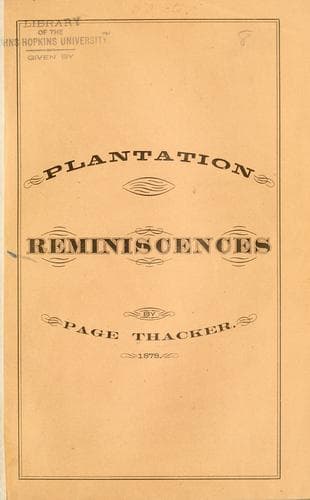
Plantation life; Virginia -- Social life and customs
Then our ancestors performed a great work--the work allotted them
by God, civilizing and elevating an inferior race in the scale of
intelligence and comfort. That this race may continue to improve, and
finally be the means of carrying the gospel into their native Africa,
should be the prayer of every earnest Christian.
Never again will the negro race find a people so kind and true to them
as the Southerners have been. For, said a gentleman the other day, who
lives in New York, "In the Northern cities white labor is preferred,
and the negroes are to be found on the outskirts, poor, wretched and
friendless."
There is much in our lives not intended for us to comprehend or
explain; but believing that nothing happens by chance, and that our
forefathers have done their duty in the "place it had pleased God to
call them," let us cherish their memory, and remember that the Lord God
Omnipotent reigneth.
For He who rules each wondrous star,
And marks the feeble sparrow's fall
Controls the destiny of man,
And guides events however small.
Man's place of birth; his home; his friends,
Are planned and fixed by God alone--
"Life's lot is cast"--e'en death He sends
For some wise purpose of His own.
FOOTNOTES:
[1] Rev. G. W. Leyburn.
[2] John Randolph, of Roanoke.
[3] John Preston, afterwards Governor of Virginia.
[4] On the route to "Rustic" was a small village called "Liberty,"
approaching which, and hearing the name, "English Louis" swore he would
not pass through any such "---- little Republican town," and turning
his horses travelled many miles out of his way to avoid it.
[5] From this vicinity went nine ministers, who were eminent in their
several churches; two Episcopal Bishops, one Methodist Bishop, three
distinguished Presbyterian and three Baptist divines of talent and fame.
[6] General Scott.
[7] Harpers Ferry.
[8] Here was seen the Mount Vernon silver, which had descended to Mrs.
General Washington's great-grandson, General Custis Lee, and which
was miraculously preserved during the war, having been concealed in
different places--and once was buried near Lexington in a barn, which
was occupied by the enemy several days.
* * * * * *
Transcriber's note:
Every effort has been made to replicate this text as faithfully as
possible, including inconsistent hyphenation.
The following is a list of changes made to the original.
The first line is the original line, the second the corrected one.
Page 12:
small servants, who speedily gat them into their clean aprons,
small servants, who speedily got them into their clean aprons,
Page 16:
Every inch of mahogony was waxed and rubbed to the highest state
Every inch of mahogany was waxed and rubbed to the highest state
Page 20:
and which always looked so pretty on the mahogony.
and which always looked so pretty on the mahogany.
Page 29:
Public-domain text, read in full here on John Shaqi.
Reviews
Reviews
No reviews yet
Be the first to share your thoughts on this work.
Elsewhere in the archive
Join the Discussion
Join the discussion
Sign in to leave a comment or review.
Sign InorCreate an account