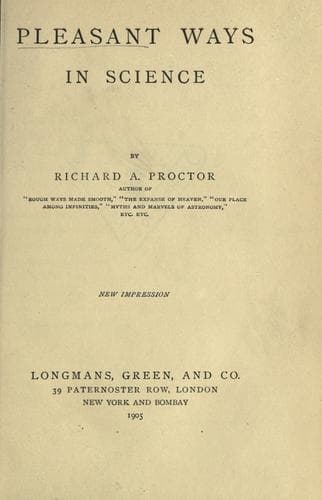
Pleasant Ways in ScienceProctor, Richard A. (Richard Anthony)
Science
Pleasant Ways in Science
Proctor, Richard A. (Richard Anthony)
Science
Since the whole heavens contain but 5932 stars visible to the naked
eye, each of the maps should contain on the average about 593 stars.
But instead of this being the case, some of the maps contain many more
than their just proportion of stars, while in others the number as
greatly falls short of the average. One recognizes, by combining these
indications, the existence of a roughly circular region, rich in stars,
in the northern heavens, and of another, larger and richer, in the
southern hemisphere.
To show the influence of these rich regions, it is only necessary to
exhibit the numerical relations presented by the maps.
The north-polar map, in which the largest part of the northern rich
region falls, contains no less than 693 lucid stars, of which upwards
of 400 fall within the half corresponding to the rich region. Of the
adjacent maps, two contain upwards of 500 stars, while the remaining
three contain about 400 each. Passing to the southern hemisphere, we
find that the south-polar map, which falls wholly within a rich region,
contains no less than 1132 stars! One of the adjacent maps contains 834
stars, and the four others exhibit numbers ranging from 527 to 595.
It is wholly impossible not to recognize so unequal a distribution as
exhibiting the existence of special laws of stellar aggregation.
It is noteworthy, too, that the greater Magellanic cloud falls in
the heart of the southern rich region. Were there not other signs
that this wonderful object is really associated with the sidereal
system, it might be rash to recognize this relation as indicating the
existence of a physical connection between the Nubecula Major and
the southern region rich in stars. Astronomers have indeed so long
regarded the Nubeculæ as belonging neither to the sidereal nor to the
nebular systems, that they are not likely to recognize very readily
the existence of any such connection. Yet how strangely perverse is
the reasoning which has led astronomers so to regard these amazing
objects. Presented fairly, that reasoning amounts simply to this: The
Magellanic clouds contain stars and they contain nebulæ; therefore
they are neither nebular nor stellar. Can perversity of reasoning be
pushed further? Is not the obvious conclusion this, that since nebulæ
and stars are _seen_ to be intermixed in the Nubeculæ, the nebular and
stellar systems form in reality but one complex system?
Public-domain text, read in full here on John Shaqi.
Reviews
Reviews
No reviews yet
Be the first to share your thoughts on this work.
Elsewhere in the archive
Join the Discussion
Join the discussion
Sign in to leave a comment or review.
Sign InorCreate an account