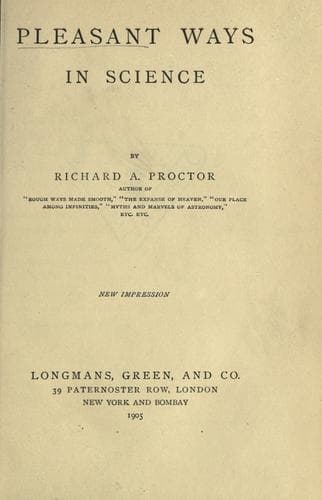
Pleasant Ways in ScienceProctor, Richard A. (Richard Anthony)
Science
Pleasant Ways in Science
Proctor, Richard A. (Richard Anthony)
Science
As to the existence of star-streams and clustering aggregations, we
have also evidence of a decisive character. There is a well-marked
stream of stars running from near Capella towards Monoceros. Beyond
this lies a long dark rift altogether bare of lucid orbs, beyond which
again lies an extensive range of stars, covering Gemini, Cancer, and
the southern parts of Leo. This vast system of stars resembles a
gigantic sidereal billow flowing towards the Milky Way as towards some
mighty shore-line. Nor is this description altogether fanciful; since
one of the most marked instances of star-drift presently to be adduced
refers to this very region. These associated stars _are_ urging their
way towards the galaxy, and that at a rate which, though seemingly slow
when viewed from beyond so enormous a gap as separates us from this
system, must in reality be estimated by millions of miles in every year.
Other streams and clustering aggregations there are which need not
here be specially described. But it is worth noticing that all the
well-marked streams recognized by the ancients seem closely associated
with the southern rich region already referred to. This is true of the
stars forming the River Eridanus, the serpent Hydra, and the streams
from the water-can of Aquarius. It is also noteworthy that in each
instance a portion of the stream lies outside the rich region, the rest
within it; while all the streams which lie on the same side of the
galaxy tend towards the two Magellanic clouds.
Most intimate signs of association between lucid stars and the galaxy
can be recognized—(i.) in the part extending from Cygnus to Aquila;
(ii.) in the part from Perseus to Monoceros; (iii.) over the ship Argo;
and (iv.) near Crux and the feet of Centaurus.
Before proceeding to the subject of Star-drift, three broad facts may
be stated. They are, I believe, now recognized for the first time, and
seem decisive of the existence of special laws of distribution among
the stars:—
First, the rich southern region, though covering but a sixth part of
the heavens, contains one-third of all the lucid stars, leaving only
two-thirds for the remaining five-sixths of the heavens.
Secondly, if the two rich regions and the Milky Way be considered as
one part of the heavens, the rest as another, then the former part is
three times as richly strewn with lucid stars as the second.
Thirdly, the southern hemisphere contains one thousand more lucid
stars than the northern, a fact which cannot but be regarded as most
striking when it is remembered that the total number of stars visible
to ordinary eyesight in both hemispheres falls short of 6000.
Two or three years ago, the idea suggested itself to me that if
the proper motions of the stars were examined, they would be found
to convey clear information respecting the existence of variety of
structure, and special laws of distribution within the sidereal system.
Public-domain text, read in full here on John Shaqi.
Reviews
Reviews
No reviews yet
Be the first to share your thoughts on this work.
Elsewhere in the archive
Join the Discussion
Join the discussion
Sign in to leave a comment or review.
Sign InorCreate an account