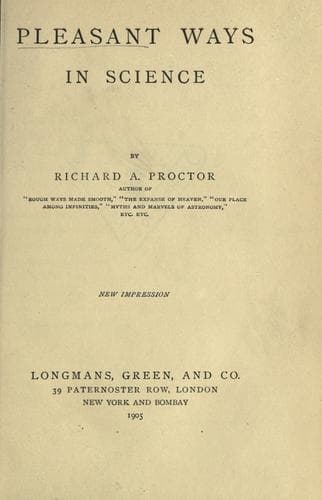
Pleasant Ways in ScienceProctor, Richard A. (Richard Anthony)
Science
Pleasant Ways in Science
Proctor, Richard A. (Richard Anthony)
Science
It remains that I should exhibit the general results to which I have
been led. It has seemed to many that my views tend largely to diminish
our estimate of the extent of the sidereal system. The exact reverse
is the case. According to accepted views there lie within the range of
our most powerful telescopes millions of millions of suns. According
to mine the primary suns within the range of our telescopes must be
counted by tens of thousands, or by hundreds of thousands at the
outside. What does this diminution of numbers imply but that the space
separating sun from sun is enormously greater than accepted theories
would permit? And this increase implies an enormous increase in the
estimate we are to form of the vital energies of individual suns. For
the vitality of a sun, if one may be permitted the expression, is
measured not merely by the amount of matter over which it exercises
control, but by the extent of space within which that matter is
distributed. Take an orb a thousand times vaster than our sun, and
spread over its surface an amount of matter exceeding a thousandfold
the combined mass of all the planets of the solar system:—So far as
living force is concerned, the result is—_nil_. But distribute that
matter throughout a vast space all round the orb:—That orb becomes
at once fit to be the centre of a host of dependent worlds. Again,
according to accepted theories, when the astronomer has succeeded in
resolving the milky light of a portion of the galaxy into stars, he
has in that direction, at any rate, reached the limits of the sidereal
system. According to my views, what he has really done has been but to
analyze a definite aggregation of stars, a mere corner of that great
system. Yet once more, according to accepted views, thousands and
thousands of galaxies, external to the sidereal system, can be seen
with powerful telescopes. If I am right, the external star-systems lie
far beyond the reach of the most powerful telescope man has yet been
able to construct, insomuch that perchance the nearest of the outlying
galaxies may lie a million times beyond the range even of the mighty
mirror of the great Rosse telescope.
Public-domain text, read in full here on John Shaqi.
Reviews
Reviews
No reviews yet
Be the first to share your thoughts on this work.
Elsewhere in the archive
Join the Discussion
Join the discussion
Sign in to leave a comment or review.
Sign InorCreate an account